Showing posts with label Desert pincushion. Show all posts

Monday, June 9, 2014

Wildflowers Along Gabbs Valley Range


Part II, What's Blooming on Rabbit Springs Road


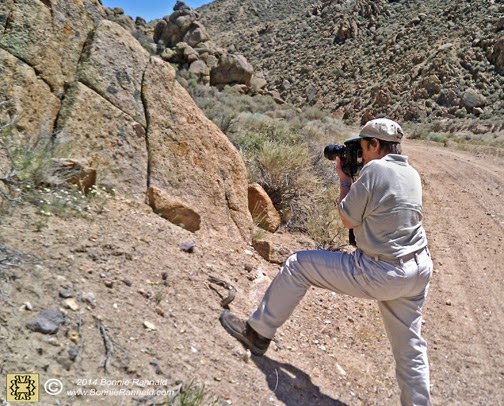
Part two on my discoveries of wildflowers along the Gabbs Valley Range takes me back to Rabbit Springs Road from the side trip to Benton Spring.  While driving a short distance, to my disappointment I began to notice that this area appeared very dry.  Most of the moisture from any clouds just happens to become stalled over the Gabbs--Reese River area; however weather patterns in this portion of the Great Basin Desert can be quite unpredictable and also fickle. 


http://www.bonnierannald.com


I was beginning to fear that the lack of moisture was not going to allow for many wildflowers on this trip. As I was driving higher up and to the north on Rabbit Springs Road, I saw my first indication with a few small white petals of Spreading Phlox.  This plant can grow to become so dense that the tiny flowers completely cover the leaves. Spreading Phlox mounds rarely grow higher than 4 inches above the ground.  Maybe my luck was about to change and I would find more flowers as I drove up higher.


http://www.bonnierannald.com


While walking around the area of the Spreading Phlox, my eyes were drawn to something red against the green needles of a pinyon pine.  A closer look found just the one Desert Paintbrush, but what a striking scene it made with the pine needles.  The Desert or Indian Paintbrush has brilliantly colored, torch-like flower spikes that range from electric pint to scarlet red.  Growing on sagebrush slopes, the Paintbrush adapts by hooking its roots to the roots of a host plant.  


http://www.bonnierannald.com


The Pinyon Pine is a low, bushy evergreen that can reach a height of 15 to 35 feet, (4.6-10.7 m) and has adapted well in the high desert soil.  Producing the edible pine nuts, the seeds are still collected by Native Americans for both cultural and economic purposes. 


http://www.bonnierannald.com


Gaining higher altitude, around 7,000 feet (2133.6 m) were a nice grouping of Silvery Lupines accenting the road-side with their deep blue-violet blooms.  A member of the pea family, Lupines are found in rocky soils at 7,000 to 10,000 feet (2,134--3,048 m) elevation.  A note of caution--the genus Lupins and especially the seeds are toxic to humans and animals if ingested.


http://www.bonnierannald.com


 Mixed in with the Silvery Lupines was an occasional Dwarf Lupine.  


http://www.bonnierannald.com


After reaching the higher altitudes more varieties of wildflowers were coming in view.  The lavender flowers of a Crescent Milk-vetch were just starting to bloom.  Preferring sandy or gravelly soils, this interesting plant is also known as Locoweed and comes with a word of caution as it is toxic to both humans and animals.  When ingested, a disorder known as locoism will result. Locoism occurs chiefly among sheep, horses and cattle and is characterized by weakness, impaired vision, paralysis and irregular behavior.  


http://www.bonnierannald.com


Just as I was driving past, I noticed the tall, deep purple blossoms of a Subalpine Larkspur.  The showy flower grows along shady, subalpine streams and meadow edges so I was curious as to why it was on the bank of this rocky dirt road.  This plant too comes with a warning and contains toxins if eaten which can be fatal to both humans and animals.  


http://www.bonnierannald.com


My drive had now taken me to the mountain pass and it was time to turn around.


 The interesting aspect of outdoor photography along a trail is that everything looks different on the trip back.  The lavender trumpet flowers of Purple Mat were blooming off to the side.  Purple Mat has been known to carpet the desert floor with ample rain.


http://www.bonnierannald.com  


A little further on, the white Desert Pincushions were just starting to bloom.   These small multiple flowerheads accent the slopes, hillsides and shrublands in many areas of the Great Basin Desert.


The last group of wildflowers to my delight was a bunch of Spreading Fleabane nestled against rust colored sandstone rocks.  The small daisy-like blossoms are short-lived, so this was a very exciting finale for a day of wildflower photos. 


http://www.bonnierannald.com


What an exciting and interesting photo-adventure this day has been.  I love it when I am drawn to an area and not knowing what to expect I get treated to new experiences. 

Sign up and follow my blog to see where my next photo-adventure will be!


Photography places me in the moment where I can share that moment in time. It becomes a life story as represented by my interaction with the scene. The happiness and beauty or the sorrow and strife; how I focus leaves a lasting impression that might touch the viewer on a spiritual level.


 "Reflecting Nature's Artistry" 


Many of these images are available on my website:

 http://www.bonnierannald.com/ 

For custom matted and framed images:
Off The Wall


No images on this blog are within Public Domain or are available for free download. 

 All rights reserved, world-wide and images protected by Digital Millennium Copyright Act (DMCA). All photography, graphics, text, design, and content is copyrighted by Bonnie Rannald and should not be copied, down-loaded, transferred and re-created in any way without the express consent, in writing to Bonnie Rannald. For information on Bonnie Rannald licensed, right-managed images, please submit a written request.


Wednesday, May 21, 2014

Wildflowers at Walker Lake, Nevada


Springtime in the Great Basin Desert!


Whether it is intense heat in the summer or frigid cold during the winter, Nature in the desert is always being challenged to adapt to harsh conditions.  These challenges, when nature must adapt to survive, present fascinating photo opportunities and are the reason that I am so drawn to the desert. 

At rare times, Nature's tenacity is revealed when conditions come together at just the right time.  The barren desert thrives and becomes a showcase of nature's bounty.  Such were the conditions during the past winter of 2013 when areas within the Great Basin Desert received adequate moisture from rain or snow. 

To the northwest of Walker Lake lies a sandy flat area facing east that is protected to the west by the Wassuk Range.  Within this area of approximately one mile radius (1.609344 km) the desert was in bloom with a number of wildflowers and shrubs.


http://www.bonnierannald.com

  
 What first caught my eye were the patches of Desert Plume accenting the landscape and standing tall over the yellow blanket of Desert Dandelions.


http://www.bonnierannald.com


The Desert Plume, Stanleya pinnata or Golden Prince's Plume can grow up to 5 feet tall (153 cm) in the alkaline soil.   The slender wands of yellow hairy flowers attract bees and other pollen gathers.


http://www.bonnierannald.com


Brilliant Desert Dandelions were growing in batches through out the region.


http://www.bonnierannald.com


One of the plants edible by humans and often the first wildflower to bloom, Desert Dandelions provide vital nourishment for bees coming through the winter.


http://www.bonnierannald.com


My timing for these wildflower photos was right on since the Spiny Hop Sage Grayia spinosa was in bloom throughout the desert.


http://www.bonnierannald.com


The small shrub of Spiny Hop Sage only shows its colorful fruit for a short duration in spring and then turns into a woody gray thicket when the climate dries and begins to warm. 


http://www.bonnierannald.com


Even the Burrobush Hymenoclea salsola or Cheesebush was showcasing its tiny white flowers.  Its common name Cheesebush is due to the pungent odor when the leaves are crushed.


http://www.bonnierannald.com


The broom like shrub of Mormon Tea was just beginning to show buds.  Mormon Tea gets its name from the early Mormon settlers who brewed a tea from the stems and leaves.  The tea was also used by Native Americans for stomach disorders and made into poultices for burns or sores on the skin. 


http://www.bonnierannald.com


Many of the wildflower seeds are annuals or ephemerals like the Desert pincushion.  Their seeds lay dormant waiting for just the right amount of moisture and sunlight. At which time they will spring to life thriving only for a short period to be pollinated by bees, butterflies and hummingbirds before the climate becomes too hot or dry.  


http://www.bonnierannald.com


Unlike annuals that last only for a season desert plants that are considered perennials, as with the Tufted Evening-primrose will re-bloom and come out of dormancy only when adequate water becomes available. 


http://www.bonnierannald.com


A variety of other flowers and shrubs were just beginning to bloom.  It will be interesting to return in a few days and after the latest rains to see what else is there, waiting for my camera. 


http://www.bonnierannald.com


What an exciting and interesting photo-adventure this day has been.  I love it when I am drawn to an area and not knowing what to expect I get treated to new experiences. 

Sign up and follow my blog to see where my next photo-adventure will be!


Photography places me in the moment where I can share that moment in time. It becomes a life story as represented by my interaction with the scene. The happiness and beauty or the sorrow and strife; how I focus leaves a lasting impression that might touch the viewer on a spiritual level.


 "Reflecting Nature's Artistry" 


Many of these images are available on my website:

 http://www.bonnierannald.com/ 

For custom matted and framed images:
Off The Wall


No images on this blog are within Public Domain or are available for free download. 

 All rights reserved, world-wide and images protected by Digital Millennium Copyright Act (DMCA). All photography, graphics, text, design, and content is copyrighted by Bonnie Rannald and should not be copied, down-loaded, transferred and re-created in any way without the express consent, in writing to Bonnie Rannald. For information on Bonnie Rannald licensed, right-managed images, please submit a written request.