Thursday, July 28, 2011

Northern Bluet Damselfly

 Walker Lake Water Fairies


During the month of July, the lapis blue of the Northern Bluet Damselfly accents green bushes and shallow waters around Walker Lake.


These strikingly delicate creatures are insects similar to dragonflies, in the order Odonata and the suborder Zygoptera.  However the Damselfly is smaller than a dragonfly and its wings are held along the body when at rest. 


 The male is a striking blue. 


While the female is a duller slate color. 


Damselflies have a life cycle of one to two years and can often be seen mating in flight or by clinging to plants. 


After copulation, the female will lay her eggs in submerged vegetation.  Once the eggs are laid, she will continue this process.
  

Upon hatching, the damselfly does not go through the larva and pupa transformation.  It will emerge in to a nymph as a smaller version of the mature damselfly where it spends one to three years in the water preying on smaller aquatic insects.


After molting several times, the damselfly enters the adult stage where it keeps nature in balance eating flies, mosquitoes and other insects.


It's a wondrous sight to just sit and imagine the elegant damselflies as water fairies flying around Walker Lake on a warm day in July. 


 For additional reading:

http://www.lrdg.org.uk/articles/intro.php

http://www.cirrusimage.com/damselfly.htm

http://crawford.tardigrade.net/bugs/BugofMonth12.html

http://en.wikipedia.org/wiki/Damselfly


What an exciting and interesting photo-adventure this day has been.  I love it when I am drawn to an area and not knowing what to expect I get treated to new experiences. 

Sign up and follow my blog to see where my next photo-adventure will be!


Photography places me in the moment where I can share that moment in time. It becomes a life story as represented by my interaction with the scene. The happiness and beauty or the sorrow and strife; how I focus leaves a lasting impression that might touch the viewer on a spiritual level.


 "Reflecting Nature's Artistry" 


Many of these images are available on my website:

 http://www.bonnierannald.com/ 

For custom matted and framed images:
Off The Wall


No images on this blog are within Public Domain or are available for free download. 

 All rights reserved, world-wide and images protected by Digital Millennium Copyright Act (DMCA). All photography, graphics, text, design, and content is copyrighted by Bonnie Rannald and should not be copied, down-loaded, transferred and re-created in any way without the express consent, in writing to Bonnie Rannald. For information on Bonnie Rannald licensed, right-managed images, please submit a written request.


Wednesday, July 20, 2011

2011 Purple Summer Festival


Arts, Music and Culinary Delights at Lavender Ridge


I've just returned from participating in the Purple Summer Festival at Lavender Ridge, in Reno, Nevada. The Purple Summer Festival has become the top art festival and is held on the third weekend of July, during Artown, when the city of Reno is focused on the arts.


Lavender Ridge is a lavender farm with a setting that is just perfect for a celebration of the arts.  Owners Kristy and Mike Harris go all out providing the Reno community with a diverse selection of fine arts, culinary delights flavored with lavender and live music performances under the gazebo.


I've been fortunate to be a vendor with my PhotoGraphic Expressions since the beginning of the Purple Summer Festival.  Each year the festival gets better and more exciting.


The highlights of the 2011 festival including the diverse selection of mix media artists was the lavender beer that was so refreshing on a warm summer day and the entertainment by the Gabardine Sisters and their Homespun Harmony Hour.


The Homespun Harmony Hour with the Gabardine Sisters: Joyce Furlong as Dinah Gabardine, Karla Bowman as Tulla Gabardine, and Annie Pinkerton as Nettie Gabardine, perform a "live radio show"  with the call letters KQLT from the make-believe town of Cotton Creek.   The back-up band House Blend with guitarist Riley Hayes and Hobart "Geezer" Gaddy on upright bass play accompaniment to the three-part harmony of the Sisters.  


What a beautiful setting to enjoy the arts while sipping lavender lemonade by the cool waterfall that overlooks fields of lavender flowers.  Lavender Ridge is located on 7450 West 4th. Street, in Reno, Nevada.  (775) 747-3222.


To contact the Gabardine Sisters:
(775) 722-9877
Joyce Furlong


What an exciting and interesting photo-adventure this day has been.  I love it when I am drawn to an area and not knowing what to expect I get treated to new experiences. 

Sign up and follow my blog to see where my next photo-adventure will be!


Photography places me in the moment where I can share that moment in time. It becomes a life story as represented by my interaction with the scene. The happiness and beauty or the sorrow and strife; how I focus leaves a lasting impression that might touch the viewer on a spiritual level.


 "Reflecting Nature's Artistry" 


Many of these images are available on my website:

 http://www.bonnierannald.com/ 

For custom matted and framed images:
Off The Wall


No images on this blog are within Public Domain or are available for free download. 

 All rights reserved, world-wide and images protected by Digital Millennium Copyright Act (DMCA). All photography, graphics, text, design, and content is copyrighted by Bonnie Rannald and should not be copied, down-loaded, transferred and re-created in any way without the express consent, in writing to Bonnie Rannald. For information on Bonnie Rannald licensed, right-managed images, please submit a written request.


Visit our website at: http://www.bonnierannald.com/


Thursday, July 7, 2011

Pyrotechnics in the Desert

 Star Spangled Fifth of July

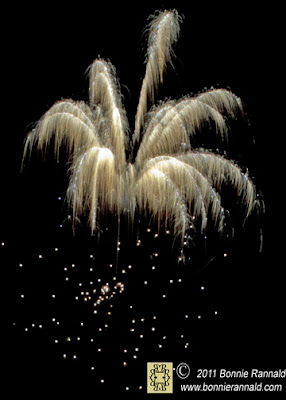
On July 5th., the mountain enclosed sky at Hawthorne, Nevada comes alive with a star spangled celebration for Independence Day.  By holding the 4th. of July celebration a day late, the small desert town can catch the Fireworks Display Companies after the big city celebrations where they can use up left over pyrotechnics.  This year, the left over’s put on one very spectacular display. 


Anyone who has spent much time with me knows that of the two things I love to photo, fireworks is right up there with lightning.  Well, the word  photography is of Greek origin, meaning to write with light and with both lightning and fireworks, I am literally "writing with light"!


For this year's fireworks event, I set up in the desert approximately 400 meters from the display area, with the wind direction blowing cross wind from my left.


 This position turned out to be just perfect and the wind drift created some interesting effects with the bursts.  


With my Nikon D90 secured to my heavier Bogan tripod, I chose the Nikon 35-70mm 2.8 lens because a wide angle lens works better with fireworks to frame as much sky as possible.  The D90 was set on Manual Mode and by using a remote cable, I held the shutter open on Bulb setting.  
With Bulb, I have control over the shutter speed and can keep it open for long exposures where the fireworks become streaked.
Or time it just right to freeze the action on one burst. 


The pyrotechnics in this year's show were outstanding, making it very difficult for me to select just a few of the best 80 images.  To see more of the July 5, 2011 fireworks display, please visit my Bonnie Rannald's PhotoGraphic Expressions Facebook Artist Page.


What an exciting and interesting photo-adventure this day has been.  I love it when I am drawn to an area and not knowing what to expect I get treated to new experiences. 

Sign up and follow my blog to see where my next photo-adventure will be!


Photography places me in the moment where I can share that moment in time. It becomes a life story as represented by my interaction with the scene. The happiness and beauty or the sorrow and strife; how I focus leaves a lasting impression that might touch the viewer on a spiritual level.


 "Reflecting Nature's Artistry" 


Many of these images are available on my website:

 http://www.bonnierannald.com/ 

For custom matted and framed images:
Off The Wall


No images on this blog are within Public Domain or are available for free download. 

 All rights reserved, world-wide and images protected by Digital Millennium Copyright Act (DMCA). All photography, graphics, text, design, and content is copyrighted by Bonnie Rannald and should not be copied, down-loaded, transferred and re-created in any way without the express consent, in writing to Bonnie Rannald. For information on Bonnie Rannald licensed, right-managed images, please submit a written request.


Monday, June 27, 2011

Attracting Birds, Bees and Butterflies

Flowering Plants in a High Desert Yard


Trying to accent a yard in the Great Basin Desert with attractive wildlife friendly plants has been a learning experience of trial and error for me.  The Great Basin is the largest desert in the U.S. and is considered a "Cold Desert" due to its northern location and higher elevations that average between 4,000 feet 1219.2 m to 6,500 feet 1828.8 m.  The more southern area of the Great Basin where I am located averages less than 7 inches 17.78 cm of perception a year.  Nestled between the Wassuk and Gillis mountain ranges, the winters can be cold with temperatures reaching below freezing and the summers can be harsh with the sun shining down through the clear blue sky. 

Trying to grow the usual flowers and shrubs that adorn most yards just ends in disappointment when the plants struggle for survival and eventually die.   However being a wildlife photographer, I wanted a yard that was attractive for the various birds and insects and would offer me a place to relax and enjoy the scenery. 


  Pygmy Blue Butterfly on Rosemary Blossom


The flowers and shrubs that thrive and bring so much color and various forms of wildlife to my yard are as follows:

One of the most unusual flowering shrubs is the Caesalpinia gilliesii or commonly known as Bird of Paradise Bush.  A member of the legume family, the Bird of Paradise Bush is native to Argentina.  It thrives in my area, especially with some extra water during the hot summer.  The yellow flowers attract hummingbirds and butterflies.


Apricot Globe Mallow is an annual flowering plant native to the southwestern desert. Growing along washes, the orange flowers provide pollen and nectar for bees, hummingbirds and butterflies.  It is also a staple in the diet of the Desert Bighorn Sheep. 


The deep blue Salvia of the mint family thrives in full sun and will keep flowering with a little extra water during the dry spells.  It is a favorite with the hummingbirds and butterflies, but repels deer and rabbits.


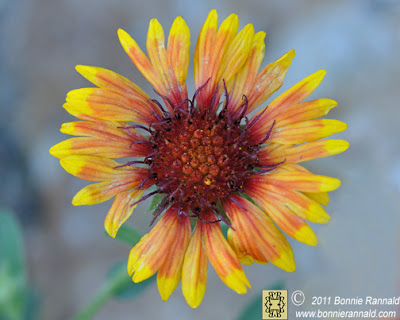
Gaillardia or blanket flower accents the planting beds with large daisy like blooms.  A sun and heat loving plant, the blanket flower attracts hummingbirds, butterflies and small birds that eat the seeds.


Sunflowers are my favorite flowers and just happen to do so well here that I have to thin them out.  They come up all over the yard from seeds blown by the wind or dropped by wildlife.  The seeds are a food staple for birds and ground squirrels.  Bees and butterflies are drawn to the flowers and I have even watched hummingbirds visit the flowers.


Desert Willows are native to the Mojave Desert. They reach a height of 25 feet, 7.6m and grow along washes at elevations between 1000-5000 feet, 305-1524 meters.  I brought some small Desert Willow transplants from my yard in Las Vegas and they are thriving here!  The hummingbirds, moths and butterflies are drawn to the nectar.   What a wonderful tree that decorates the landscape while providing shade and shelter.


I have many other different varieties of plants in my yard including junipers, elms, various grasses and an almond tree. However, the plants that I've focused on in this post are the summer flowering kind.  A few years ago, the yard was certified by the National Wildlife Federation as a wildlife friendly habitat.  So I can just sit back, relax and enjoy the outdoors whenever I feel the urge.

For additional reading:
http://bonnierannald.blogspot.com/2010/09/xeriscaping-in-high-desert.htm


What an exciting and interesting photo-adventure this day has been.  I love it when I am drawn to an area and not knowing what to expect I get treated to new experiences. 

Sign up and follow my blog to see where my next photo-adventure will be!


Photography places me in the moment where I can share that moment in time. It becomes a life story as represented by my interaction with the scene. The happiness and beauty or the sorrow and strife; how I focus leaves a lasting impression that might touch the viewer on a spiritual level.


 "Reflecting Nature's Artistry" 


Many of these images are available on my website:

 http://www.bonnierannald.com/ 

For custom matted and framed images:
Off The Wall


No images on this blog are within Public Domain or are available for free download. 

 All rights reserved, world-wide and images protected by Digital Millennium Copyright Act (DMCA). All photography, graphics, text, design, and content is copyrighted by Bonnie Rannald and should not be copied, down-loaded, transferred and re-created in any way without the express consent, in writing to Bonnie Rannald. For information on Bonnie Rannald licensed, right-managed images, please submit a written request.


Monday, June 20, 2011

Bad Photos Exposed


How Not to Take a Bad Photo

I'm writing this entry in reference to a comment on one of my Facebook posts from a friend who wrote "Can't you just post one lousy crappy photo? Just once?!"  Well my friend, you've given me some food for thought and the more I thought about your comment the more I realized that yes, I’m always talking about the good photos.  Now it's time to confess, show off the mistakes and ones that do not make the final Save As file.  It took me a while to locate some bad ones because they usually are sent to the delete bin after processing. 

One of the most difficult decisions for a photographer is to delete the poor ones from the good quality.  Below are some examples of my photographs that have technical problems and will not make the cut!

On first glance, the dancer's photo appears to be nice and strong; however a closer look at his body shows exposure problems.  With much of the editing software, including Lightroom, the exposure problem can be fixed, to a point.  However with digital, once the highlights are blown out or clipped, they can not be recovered.


The wild horses and coyote at Walker Lake would have made a nice photo had the wind not been blowing so hard to cause camera shake. The white streaks in the background are white caps on the lake. Even by increasing the ISO, the force of the wind was just too hard and the photo is not sharp.


  The Northern Flicker would have been a nice photo if the background was not so busy and distracting.  A slight move to the right or left might have remedied the problem.


Ah, a grave site at the historical Aurora mining town cemetery. The contrasty lighting makes the image hard to see and the brick pillars create a barrier.  Photographing the scene when the sun was at more of an angle would be nice.  However if time will not allow, firing the flash and a side view would give a much stronger image.


An overexposed full moon lacking any detail was caused from rushing the photo without taking in to consideration the overexposure tendency of the digital camera and also not using spot metering.  The moon is so much brighter than the sky or landscape and spot metering will allow for a more accurate setting.


One of my favorite mistakes and what I call: "Premature Shutter Clicking".  I do this quite often by clicking the shutter in anticipation of the shot before I am in focus.


So often with wildlife, we are rushed to get a photo before the animal disappears.  However, a little patience and tracking the animal in focus usually rewards me with a better image.


I just can't seem to get past the obstruction of the leaves in front of the robin, so I click the shutter, hoping for the best.  Well in most cases the best just is not good enough when you are working for a sell-able commercial image.


Hum, what was the main subject that I was trying to portray in my photo?  This scene has so many different subjects that it's hard to tell.  All I needed to do was step back and decide what message I was trying to send to the viewer.


This is one of my favorites when trying to photograph a fast moving subject.  I've seen more out of focus and blank frames that go straight to the delete file.  The beauty of digital is, you can take numerous images and not worry about having to change film.

I was trying to get an action shot with a Costa's Hummingbird, but the lighting was wrong and the projectiles sticking up create a barrier and are distracting.  Sometimes nature just doesn't want to cooperate.


When the distance is too far and exceeds the limits of the lens, all you can do is take a shot and hope for the best.  Sometimes you can crop in and the subject will be sharp enough for a decent photo.


My favorite of all poor quality photos is not using a tripod so that I can get the sharp focus on my subject.  Tripods are inconvenient and have to be set up, however the sharpness of the image is worth the extra effort.

So yes, even I take lousy, crappy photos sometimes.  But I also know that the true difference between taking photos and creating images is the finished results within the scene.


What an exciting and interesting photo-adventure this day has been.  I love it when I am drawn to an area and not knowing what to expect I get treated to new experiences. 

Sign up and follow my blog to see where my next photo-adventure will be!


Photography places me in the moment where I can share that moment in time. It becomes a life story as represented by my interaction with the scene. The happiness and beauty or the sorrow and strife; how I focus leaves a lasting impression that might touch the viewer on a spiritual level.


 "Reflecting Nature's Artistry" 


Many of these images are available on my website:

 http://www.bonnierannald.com/ 

For custom matted and framed images:
Off The Wall


No images on this blog are within Public Domain or are available for free download. 

 All rights reserved, world-wide and images protected by Digital Millennium Copyright Act (DMCA). All photography, graphics, text, design, and content is copyrighted by Bonnie Rannald and should not be copied, down-loaded, transferred and re-created in any way without the express consent, in writing to Bonnie Rannald. For information on Bonnie Rannald licensed, right-managed images, please submit a written request.


Monday, June 13, 2011

Photographing Butterflies

 The Illusive Butterfly
Trying to freeze the illusive butterfly in the lens of the camera can be both a rewarding and frustrating experience.  I was in southern New Mexico one summer when the Western Tiger Swallowtail butterflies were out in mass, feeding on the flowering thistles.  All I had to do was just stand nearby, clicking the shutter.
 
Western Tiger Swallowtail 

Most of the time, it is not so easy to get up close and the butterfly just refuses to be still.  Due to its survival instinct to flee from predators, the butterfly reacts to any movement, especially when the shadow from a moving body comes near.

Monarch

 
The time to photo a butterfly when it will remain still is in the early morning, before the sun catches its wings.  The butterfly’s metabolism slows down at night or when it is cool. In the early morning, the wings are spread to absorb heat before the butterfly can start moving them to begin feeding. 

Mourning Cloak

Having the camera on a tripod with a macro or telephoto lens allows you to get close to the butterfly and concentrate on the areas for sharp focus, which are the body and wings.
 Pygmy Blue
 By increasing the ISO, you can get a faster shutter speed in order to freeze the movement of the wings.  As in macro photography, I try and keep the lens parallel to the area of sharpest focus. 


Painted Lady

Frontal lighting is important to highlight the butterfly and bring out the accents and beautiful colors.

Pygmy Blue
Most often, if you remain still the butterfly will return to the nearby flower.  A little patience and preparation by pre-focusing on the flower also has given me good results.  I have heard that butterflies will not fly away if you wear dark clothes.  However I can not guarantee this since most times when I'm doing nature photography, I wear light, neutral colors.


 Zephyr Angelwing


What an exciting and interesting photo-adventure this day has been.  I love it when I am drawn to an area and not knowing what to expect I get treated to new experiences. 

Sign up and follow my blog to see where my next photo-adventure will be!


Photography places me in the moment where I can share that moment in time. It becomes a life story as represented by my interaction with the scene. The happiness and beauty or the sorrow and strife; how I focus leaves a lasting impression that might touch the viewer on a spiritual level.


 "Reflecting Nature's Artistry" 


Many of these images are available on my website:

 http://www.bonnierannald.com/ 

For custom matted and framed images:
Off The Wall


No images on this blog are within Public Domain or are available for free download. 

 All rights reserved, world-wide and images protected by Digital Millennium Copyright Act (DMCA). All photography, graphics, text, design, and content is copyrighted by Bonnie Rannald and should not be copied, down-loaded, transferred and re-created in any way without the express consent, in writing to Bonnie Rannald. For information on Bonnie Rannald licensed, right-managed images, please submit a written request.