Tuesday, March 17, 2015

Spring Comes to the Great Basin


First Signs of Spring with the Vernal Equinox


Winters in the Great Basin Desert can be very drab with only the deep blue sky to brighten up the landscape.  As the Northern Hemisphere begins to tilt toward the sun bringing longer days, the desert begins its transition and slowly awakens with the first signs of spring.  

 A bee gathers pollen from one of the rosemary flowers.  Rosemary is the first plant to have blooms and is always buzzing with bees or butterflies. 


One of the few remaining robins lands on the fence, a winter visitor to brighten the dull landscape, they will move further north as the temperature warms.


 Filaree storksbill comes alive as the days first begin to warm. 


http://www.bonnierannald.com


 The tiny lavender flowers provide nectar for the brown argus butterfly where an egg for each larva is laid on the underside of a leaf.   


The yellow blooms of wild mustard begin to accent the ground, often considered a weed; the entire plant is edible from the root to the flowers.  The young leaves make a nice addition to salads, while the seed pods add a peppery accent.   


http://www.bonnierannald.com


Daffodils or Narcissus, a true sign of spring, have slowly poked up and are just about ready to open. 


http://www.bonnierannald.com


 Symbolizing rebirth and new beginnings, the yellow fragile flowers are one of my favorites, reminding me of my grandmother's yard. 

http://www.bonnierannald.com

Sharp leaves of bluish green spring up, the tulip is coming out from its cool dormancy.  Soon a brilliant red flower will appear.


http://www.bonnierannald.com


In just a few days, the Earth's axis will tilt to 23.4 °, bringing equal hours of day and night.  The Vernal Equinox comes to the Great Basin at 3:45 PM PDT on March 20th.  As with ancient cultures, the Vernal Equinox to the High Desert of Nevada is also a symbol of returning food supplies and renewal of new beginnings from the drabness of winter. 


http://www.bonnierannald.com


 Follow me on my future blog posts as I explore more of the new beginnings as spring slowly turns to summer.  


What an exciting and interesting photo-adventure this day has been.  I love it when I am drawn to an area and not knowing what to expect I get treated to new experiences. 

Sign up and follow my blog to see where my next photo-adventure will be!


Photography places me in the moment where I can share that moment in time. It becomes a life story as represented by my interaction with the scene. The happiness and beauty or the sorrow and strife; how I focus leaves a lasting impression that might touch the viewer on a spiritual level.


 "Reflecting Nature's Artistry" 


Many of these images are available on my website:

 http://www.bonnierannald.com/ 

For custom matted and framed images:
Off The Wall


No images on this blog are within Public Domain or are available for free download. 

 All rights reserved, world-wide and images protected by Digital Millennium Copyright Act (DMCA). All photography, graphics, text, design, and content is copyrighted by Bonnie Rannald and should not be copied, down-loaded, transferred and re-created in any way without the express consent, in writing to Bonnie Rannald. For information on Bonnie Rannald licensed, right-managed images, please submit a written request.


Saturday, February 28, 2015

Tunneling Back to Jurassic Times


A Mystery Tunnel  to where?
  

When I was a child, learning of a secret was always very exciting and I have never outgrown that thrill.  One of the things I love most when I am out photo-exploring is being drawn to look beyond what I might be focusing on.  I believe at times like this a secret is about to be revealed, if I stop and take notice.  This was certainly the experience on a mild winter day in February when I was venturing toward the Singatse Ridge, west of Yerington, Nevada.

I had stopped to photograph an unusual outcropping of rocks that reminded me of a Dimetrodon, the dinosaur with the large sail and elongated spines on its back.

http://www.bonnierannald.com


Just as I was returning to my car,  in the distance I saw what appeared to be the opening to a large cave. 


http://www.bonnierannald.com
 

 However, when I walked closer to the opening, I realized it was a not a cave but a tunnel cut through the base of the mountain.


http://www.bonnierannald.com


 Entering the opening, I reflected on what it must have taken to tunnel out this 40 foot long, 10 foot diameter space through the massive rocks.  There was no evidence of signs or markings about this tunnel, just present day graffiti.  The tunnel was wide enough for a car or small truck but I saw no evidence of any road. 

http://www.bonnierannald.com


Since the settlers moved in, this area known as the Yerington district has been a rich source of copper mining and I began to think that the tunnel had been constructed for usage with the mining or some type of flood control. 

An interesting granodiorite boulder, an intrusive igneous rock produced from lava flows lies toward the south entrance of the tunnel.  


http://www.bonnierannald.com


Walking through the north end of the tunnel, what came to view was an intriguing outcropping of tan colored rocks.  These artistic creations of nature must have been emplaced from the Jurassic era and were just amazing.  A feeling of antiquity came over me as my eyes gazed at the lines and cracks etched by nature over eons of time.  


http://www.bonnierannald.com


A family of raptors have been taking advantage of the overhangs and depressions in the rocks as was visible by their numerous white droppings. 


http://www.bonnierannald.com


 The white paste that oozed out from the rock's edges took on interesting artistic shapes and designs. 


http://www.bonnierannald.com 


Lichens on a granodiorite bolder facing north create an array of abstract designs with the colors of the rock.


http://www.bonnierannald.com


As I turned to go back through the tunnel, I noticed a sediment line in the bank rising up to the east.  Could this layer have been deposited from ancient Lake Lahontan during the Pleistocene epoch?   


http://www.bonnierannald.com


To some, the desert may seem harsh and inhabitable, but the feeling of mystery is what draws me and when I walk quietly, the desert's secrets are often revealed. Standing and quietly watching, I began to see shapes in the rocks and then the slightest breeze lingers on my face as if the ancients are letting me know they are welcoming me to this mysterious area. 

http://www.bonnierannald.com


What an exciting and interesting photo-adventure this day has been.  I love it when I am drawn to an area and not knowing what to expect I get treated to new experiences. 

Sign up and follow my blog to see where my next photo-adventure will be!


Photography places me in the moment where I can share that moment in time. It becomes a life story as represented by my interaction with the scene. The happiness and beauty or the sorrow and strife; how I focus leaves a lasting impression that might touch the viewer on a spiritual level.


 "Reflecting Nature's Artistry" 


Many of these images are available on my website:

 http://www.bonnierannald.com/ 

For custom matted and framed images:
Off The Wall


No images on this blog are within Public Domain or are available for free download. 

 All rights reserved, world-wide and images protected by Digital Millennium Copyright Act (DMCA). All photography, graphics, text, design, and content is copyrighted by Bonnie Rannald and should not be copied, down-loaded, transferred and re-created in any way without the express consent, in writing to Bonnie Rannald. For information on Bonnie Rannald licensed, right-managed images, please submit a written request.


Sunday, February 15, 2015

Coyotes and Valentines, Romance is in the Air


Canis latrans singing the desert's music


With February being the month for Valentines I thought how appropriate to blog about one of the wild critters who also feels romance in the air this time of year. The month of February is most often when the coyote's attention turns from stalking a favorite snack to wooing a mate.  Coyotes are known for being good parents as both mother and father feed their pups by regurgitating food they have found while hunting.

http://www.bonnierannald.com


 Following a gestation period of only sixty days, the mother may have a litter of up to nineteen pups.  The pups mature quickly, are ready for weaning in about one month and reach their full size in a year.  Keeping a close family unit, the males most often leave the pack while the female pups remain in the unit.  

http://www.bonnierannald.com


Coyotes prefer to hunt at night in pairs, but on several hikes I have been fortunate to spot a single coyote hunting during the morning.  I have never been allowed to get too close and that is where my telephoto lens comes in.  I've been asked numerous times if I wasn't afraid of being attacked and the answer is No.  Maybe if I cornered one in a barn, but that isn't likely to ever happen. 

http://www.bonnierannald.com

A family of coyotes lived across the pasture at Spring Mountain Ranch State Park and on summer weekends I would go out to the park for exhibits and events.  One day on my drive out, I saw a duck get hit by a car.  I stopped to retrieve the dead, warm duck  in a plastic bag.  I wanted to see if one of the coyotes would come and take the duck back to the den.  Sure enough, I hardly had time to focus my camera when one of the coyotes grabbed the duck and ran back out of sight. 


http://www.bonnierannald.com


Every time I hear Andrew Lloyd Webber's "Music of the Night", I think of the coyotes singing at night.  There is something about their howls on a warm desert night that just seems right.  I will never forget during our Wildflower Photography Workshop at Death Valley hearing the coyotes break the silence in the early morning hours before dawn. 

In my opinion, Coyotes are given a very bad rap and it breaks my heart to know that they are being hunted and killed just for sport.  Coyotes do their part to keep nature in balance by eating rodents, rabbits and squirrels.  Their diet may also consist of birds, lizards, snakes, plants and fruits.  Yes, they will kill and eat cats and small dogs, which is why I keep my cats inside at night.  The main predators other than humans to coyotes are bears, wolves and mountain lions.  It makes me wonder when we continue to target all the natural predators what will keep nature in check.  


http://www.bonnierannald.com


So as long as there are the Canis latrans, the "barking dog", I will enjoy the desert night where the greatest sound is silence and I anticipate like with a blank sheet of music for nature to supply the notes


What an exciting and interesting photo-adventure this day has been.  I love it when I am drawn to an area and not knowing what to expect I get treated to new experiences. 

Sign up and follow my blog to see where my next photo-adventure will be!


Photography places me in the moment where I can share that moment in time. It becomes a life story as represented by my interaction with the scene. The happiness and beauty or the sorrow and strife; how I focus leaves a lasting impression that might touch the viewer on a spiritual level.


 "Reflecting Nature's Artistry" 


Many of these images are available on my website:

 http://www.bonnierannald.com/ 

For custom matted and framed images:
Off The Wall


No images on this blog are within Public Domain or are available for free download. 

 All rights reserved, world-wide and images protected by Digital Millennium Copyright Act (DMCA). All photography, graphics, text, design, and content is copyrighted by Bonnie Rannald and should not be copied, down-loaded, transferred and re-created in any way without the express consent, in writing to Bonnie Rannald. For information on Bonnie Rannald licensed, right-managed images, please submit a written request.


Sunday, February 8, 2015

Sharp-shinned Hawk on Southward Migration


Taking time out to pose for my camera!

Late one autumn afternoon after sundown I noticed a small raptor from my office window.  The hawk had landed on a wooden box and at first sight I thought it had sustained an injury to its beak.  After grabbing my camera and quietly slipping outside, I discovered that the hawk must have recently finished dinner and still had some left-overs clinging to its beak.  

http://www.bonnierannald.com


When I brought the photos up on my monitor, I found that this hawk was a Sharp-shinned, which is one of the smallest hawks in North America.  Males are smaller that females, so at first I thought this bird might be a male migrating southward for winter.  However, as I looked closer, I decided that the hawk was an immature bird since it was mostly brown with vertical streaks on its white under-parts.  Adult birds are blue-gray above with narrow, horizontal red-orange bars on the breast. 

http://www.bonnierannald.com


Backyard bird feeders tend to attract Sharp-shinned hawks and that is one reason why I prefer not to use the seed feeders.  Instead, I grow plants and shrubs that produce seeds and berries, allowing the birds to forage. The shrubs provide cover where the songbirds and sparrows can retreat when predators are in the area.  It is amazing to watch these small birds head for cover, almost like they are being vacuumed in. 

The small hawk must have been  traveling through for I did not notice him around the next day.  It was a nice suprise to be rewarded with a short visit and a few photos.


What an exciting and interesting photo-adventure this day has been.  I love it when I am drawn to an area and not knowing what to expect I get treated to new experiences. 

Sign up and follow my blog to see where my next photo-adventure will be!


Photography places me in the moment where I can share that moment in time. It becomes a life story as represented by my interaction with the scene. The happiness and beauty or the sorrow and strife; how I focus leaves a lasting impression that might touch the viewer on a spiritual level.


 "Reflecting Nature's Artistry" 


Many of these images are available on my website:

 http://www.bonnierannald.com/ 

For custom matted and framed images:
Off The Wall


No images on this blog are within Public Domain or are available for free download. 

 All rights reserved, world-wide and images protected by Digital Millennium Copyright Act (DMCA). All photography, graphics, text, design, and content is copyrighted by Bonnie Rannald and should not be copied, down-loaded, transferred and re-created in any way without the express consent, in writing to Bonnie Rannald. For information on Bonnie Rannald licensed, right-managed images, please submit a written request.


Thursday, January 29, 2015

Avian Cholera Outbreak at Walker Lake


Walker Lake's Water fowl in peril


Walker Lake, which should stand as a showcase for Nevada has certainly seen much adversity over the years.  The once thriving, natural high desert lake provided the  Agaicutta People (Paiute for Cutthroat Trout)   with food sources that were much more varied and higher in nutrition that our modern diets.   Fish, wildlife, water fowl and vegetation were plentiful and life was good.  Once the settlers started moving in, the Walker River, the main source of water that feeds Walker Lake, was diverted for agriculture usage.  Today, the Walker River is at least 130% over allocated.  As a result, not enough fresh water enters Walker Lake, which has caused the level to drop and the salinity to increase.  Presently, due to the high salt level, the lake is no longer able to support native fish. 

Walker Lake's origin dates back to the Pleistocene epoch, (Ice Age) when Lake Lahontan covered most of what is now the Great Basin Desert.  As the land dried and the climate warmed, Lake Lahontan began to recede, leaving a number of isolated lakes in closed basins, including Walker Lake. 

Not too long ago, Walker Lake was a thriving source of water out in the desert. It was known for the Lahontan Cutthroat Trout which could grow to 40 pounds in size.  Walker Lake was also a major stop-over for migratory birds. Located on the Pacific Flyway, the north-south travel route for American migratory birds, the water and shores provided essential food sources for the birds to rest and refuel.  


http://www.bonnierannald.com


Since the salty lake can no longer support the native fish, many of the seasonal visitors like the Common Loons that used to number in the hundreds no longer stop over at the lake. However a large number of shore birds still make Walker Lake their home, including the California Gull, American Coot, Long billed crulew and even the salt-loving Phalaropes.  


http://www.bonnierannald.com


The latest adversity to hit Walker Lake is an outbreak of Avian cholera that could put the remaining shore birds in great peril.


http://www.bonnierannald.com

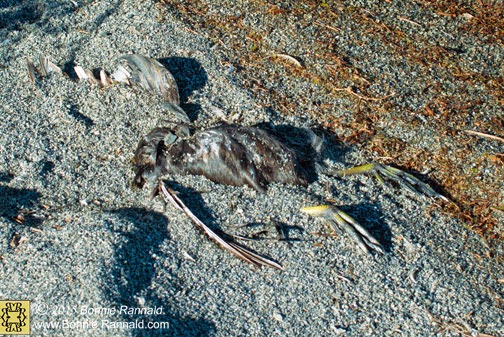
  A number of dead birds have been spotted along the shore at Walker Lake.


http://www.bonnierannald.com


  Most of the birds appear to be American Coots. 


http://www.bonnierannald.com


 There was one Mallard that appeared to have washed up on the shore.


http://www.bonnierannald.com


Avian cholera is a disease of fowl, which has crossed over from wild birds to become most prevalent in waterfowl.  The disease is found in wetland areas all across the globe and even North America.  Most of the outbreaks occur during the cold, wet weather of winter.  


http://www.bonnierannald.com

The bodies of several American Coots are caught in the tumbleweeds that line the shore.

Unfortunately once the disease is transmitted, it is almost impossible to contain. The area becomes contaminated with body secretions from diseased birds, which can remain in the water for several weeks.  It is spread by direct contact to birds that are showing various symptoms including mucous draining from the mouth, nasal discharge and blood stained diarrhea. 


http://www.bonnierannald.com


 The bacteria is ingested from contaminated food and even spread by birds scavenging on infected carcasses.  

http://www.bonnierannald.com

Avian cholera is a horrible disease and has been know to kill so quickly that birds literally die while flying and fall from the sky.


http://www.bonnierannald.com

 Infected birds may suffer convulsions, disorientation where they swim in circles, throw their heads around violently and even fly upside down.  


http://www.bonnierannald.com


The only means of containment is prompt removal and proper disposal of the dead carcasses.  I am very concerned at this time how long these birds have been lying dead and how many other birds have become diseased.  Time will surely tell and I do hope with all my being that Walker Lake will not suffer another major loss in its beauty of all the remaining birds the grace her beautiful skies.

http://www.bonnierannald.com


For additional reading:

http://bonnierannald.blogspot.com/2012/02/inland-gulls-of-walker-lake-nevada.html
http://bonnierannald.blogspot.com/2012/08/walker-lake-water-fowl.html
http://www.walkerlakenv.org/articles%204.htm

http://www.nwhc.usgs.gov/disease_information/avian_cholera/


What an exciting and interesting photo-adventure this day has been.  I love it when I am drawn to an area and not knowing what to expect I get treated to new experiences. 

Sign up and follow my blog to see where my next photo-adventure will be!


Photography places me in the moment where I can share that moment in time. It becomes a life story as represented by my interaction with the scene. The happiness and beauty or the sorrow and strife; how I focus leaves a lasting impression that might touch the viewer on a spiritual level.


 "Reflecting Nature's Artistry" 


Many of these images are available on my website:

 http://www.bonnierannald.com/ 

For custom matted and framed images:
Off The Wall


No images on this blog are within Public Domain or are available for free download. 

 All rights reserved, world-wide and images protected by Digital Millennium Copyright Act (DMCA). All photography, graphics, text, design, and content is copyrighted by Bonnie Rannald and should not be copied, down-loaded, transferred and re-created in any way without the express consent, in writing to Bonnie Rannald. For information on Bonnie Rannald licensed, right-managed images, please submit a written request.


Saturday, January 24, 2015

Alum Creek, Mineral County's Unique Ecosystem


Photo-touring in Nevada's Back Country

 
Far off the beaten path and nestled in the rugged canyons of Central Nevada lies a unique ecosystem of Piñon and tall Ponderosa's pines, where nature seems to thrive against all odds.  A small stream flows down between trees that are so huge; they must be over 100 years old.  


http://www.bonnierannald.com


This stream is Alum Creek and is located south of Lucky Boy Pass in Mineral County, Nevada.  Around the mid 1800's when mining was in it’s hey day, a creek in the Lucky Boy area flowed from Poison Spirit to Cottonwood Creek.  The presence of alum in solution was discovered in this creek so it became known as Alum Creek.  During this time, the Lucky Boy mines that were located in the Alum Creek district were producing yearly over a million dollars of silver and lead.  


http://www.bonnierannald.com


In present times, only a small trickle of water still flows down the creek bed.  With the severe drought that has been plaguing both Nevada and California, I am very surprised the creek has not completely dried up.  Over winter, even the snow pack that replenishes the ground water has become less significant.  


http://www.bonnierannald.com


With the climate warming and drying, will the pines that have created this unusual habitat still be able to adapt?   The piñon pine, Pinus edulis, native to the Southwestern U.S. will survive on available water and is drought tolerant.  Piñon can grow to 15-35 ft (4.6-10.7 m) tall and 12-24 inches (.3-.6 m) in diameter.  They produce the edible pinyon nuts which were a staple food source for the Native Americans.


http://www.bonnierannald.com


The Ponderosa pine, Pinus ponderosa is found in mountainous topography at elevations 3,000 and 9,000' (914-2700m) where there is moderate rainfall.  Mature trees can reach from 60-130' (18-39 m) with a diameter of 30-60" (9-1.7 m).  


http://www.bonnierannald.com


Alum Creek which at one time was a favorite area for family outings and picnics still offers a peaceful mountain retreat from the high desert landscape. 


http://www.bonnierannald.com


 While I sit and admire the green pines that reach for the deep blue sky, two lizards come out to warm in the sun. As I watch them I ask a silent blessing on this unique pocket that time seems to have overlooked.  I hope against all odds that the unique ecosystems of Alum Creek will have the tenacity to adjust and that we will continue to enjoy its peace and oneness of nature for many generations to come.


http://www.bonnierannald.com


What an exciting and interesting photo-adventure this day has been.  I love it when I am drawn to an area and not knowing what to expect I get treated to new experiences. 

Sign up and follow my blog to see where my next photo-adventure will be!


Photography places me in the moment where I can share that moment in time. It becomes a life story as represented by my interaction with the scene. The happiness and beauty or the sorrow and strife; how I focus leaves a lasting impression that might touch the viewer on a spiritual level.


 "Reflecting Nature's Artistry" 


Many of these images are available on my website:

 http://www.bonnierannald.com/ 

For custom matted and framed images:
Off The Wall


No images on this blog are within Public Domain or are available for free download. 

 All rights reserved, world-wide and images protected by Digital Millennium Copyright Act (DMCA). All photography, graphics, text, design, and content is copyrighted by Bonnie Rannald and should not be copied, down-loaded, transferred and re-created in any way without the express consent, in writing to Bonnie Rannald. For information on Bonnie Rannald licensed, right-managed images, please submit a written request.