Showing posts with label wildlife. Show all posts

Monday, December 24, 2012

Celebrating the Season


 Special Time for Embracing Nature

As the countdown begins toward that big time of festivities and traditions on Christmas Day, I look out my office window at the trees shuttering in the cold wind and am reminded of how I love to celebrate this special day.


 With all the rush and frenzy to buy the right gift, plus the hours in preparation for the holiday feast, there is nothing more pleasing than taking a quiet walk in nature.


  I suppose my desire to spend time in nature was developed by my dad when he took interesting drives after our big noon-time meal on the back roads in Georgia.


Christmas Day to me is a time to embrace and celebrate peace and to reflect back on treasured moments with loves ones.


 What better way to celebrate the peace than a picnic on leftovers with some hot spiced tea, surrounded by the wonders of nature.


As I reflect back over special times and cherished  memories of Christmases past, I wish to you a peaceful and joyous Holiday Season.


What an exciting and interesting photo-adventure this day has been.  I love it when I am drawn to an area and not knowing what to expect I get treated to new experiences. 

Sign up and follow my blog to see where my next photo-adventure will be!


Photography places me in the moment where I can share that moment in time. It becomes a life story as represented by my interaction with the scene. The happiness and beauty or the sorrow and strife; how I focus leaves a lasting impression that might touch the viewer on a spiritual level.


 "Reflecting Nature's Artistry" 


Many of these images are available on my website:

 http://www.bonnierannald.com/ 

For custom matted and framed images:
Off The Wall


No images on this blog are within Public Domain or are available for free download. 

 All rights reserved, world-wide and images protected by Digital Millennium Copyright Act (DMCA). All photography, graphics, text, design, and content is copyrighted by Bonnie Rannald and should not be copied, down-loaded, transferred and re-created in any way without the express consent, in writing to Bonnie Rannald. For information on Bonnie Rannald licensed, right-managed images, please submit a written request.


Monday, April 16, 2012

Newberry Rescue Farm


Bringing People and Wildlife Together


Being a wildlife photographer, nothing thrills me as much as seeing animals out in their natural habitat.  However for those who do not have this opportunity, the next best thing is to visit a rescue facility where animals are given proper treatment and a new chance for survival.  I have visited several of these facilities where I have had some great photo opportunities and learned about different types of wildlife.  


Sally Newberry is working on such a project to turn her Sally's Rescue in Washington State into the Newberry Rescue Farm.  Her dream is to enlarge her present facility through grants, donations and sponsors into an educational arena where children, adults and the disabled can come, see, touch, and have close encounters with wildlife of different types, including: llamas, goats, dogs, cats, peacocks, rabbits and guinea fowl. 


As a former teacher, I know the benefits from experiencing a close relationship with nature that teaches understanding and respect.  As a child, I was fortunate to grow up spending so much time in nature and around animals on my uncle's farm in Georgia.  For these reasons, I would like to introduce the public to Sally Newberry and her "I Have a Dream". 


 If anyone has information on grants and funding or would like to sponsor an animal for a small fee of $12.00 a month, please contact Sally through the following link:


http://dog.chipin.com/rescue-farm


What an exciting and interesting photo-adventure this day has been.  I love it when I am drawn to an area and not knowing what to expect I get treated to new experiences. 

Sign up and follow my blog to see where my next photo-adventure will be!


Photography places me in the moment where I can share that moment in time. It becomes a life story as represented by my interaction with the scene. The happiness and beauty or the sorrow and strife; how I focus leaves a lasting impression that might touch the viewer on a spiritual level.


 "Reflecting Nature's Artistry" 


Many of these images are available on my website:

 http://www.bonnierannald.com/ 

For custom matted and framed images:
Off The Wall


No images on this blog are within Public Domain or are available for free download. 

 All rights reserved, world-wide and images protected by Digital Millennium Copyright Act (DMCA). All photography, graphics, text, design, and content is copyrighted by Bonnie Rannald and should not be copied, down-loaded, transferred and re-created in any way without the express consent, in writing to Bonnie Rannald. For information on Bonnie Rannald licensed, right-managed images, please submit a written request.


Monday, January 16, 2012

Desert Bighorn Sheep at Walker Lake


 Photographing the Cliff Dwellers

  
A few weeks ago in January, early one Sunday morning as I was leaving the beach at Walker Lake, I spotted a Desert Bighorn Sheep standing on a ledge at the area knows as The Cliffs. 


Many years ago, the water level to Walker Lake was much higher and the area known as The Cliffs was underwater.  In present time the water level has receded eastward, way below the highway.


 After a short hike scrambling around the rocks, I noticed a group of at least 10 bighorns grazing on the dry desert grass. I quietly set my camera with the ISO at 800 for a faster shutter speed since the canyon was still in shadows with the morning light.


A closer look through the lens revealed that this was a herd of younger sheep and females.  Bighorn sheep have a gregarious nature and will stay together in large groups. The adult males, rams, will usually remain a part from the ewes and young in bachelor herds for most of the time.


Several sheep stop grazing to watch and a youngster peeks out from around the cliff. 


During winter, the sheep can be found in sheltered areas around the canyons and along the cliffs. 


In the warmer season, they will migrate to the upper areas.  Interestingly, the sheep may inhabit their same bedding area for many years. 


The rugged rocky cliffs allow the sure footed Bighorn sheep quick escapes from predators.   
 

Photographs Make Great Gifts


What an exciting and interesting photo-adventure this day has been.  I love it when I am drawn to an area and not knowing what to expect I get treated to new experiences. 

Sign up and follow my blog to see where my next photo-adventure will be!


Photography places me in the moment where I can share that moment in time. It becomes a life story as represented by my interaction with the scene. The happiness and beauty or the sorrow and strife; how I focus leaves a lasting impression that might touch the viewer on a spiritual level.


 "Reflecting Nature's Artistry" 


Many of these images are available on my website:

 http://www.bonnierannald.com/ 

For custom matted and framed images:
Off The Wall


No images on this blog are within Public Domain or are available for free download. 

 All rights reserved, world-wide and images protected by Digital Millennium Copyright Act (DMCA). All photography, graphics, text, design, and content is copyrighted by Bonnie Rannald and should not be copied, down-loaded, transferred and re-created in any way without the express consent, in writing to Bonnie Rannald. For information on Bonnie Rannald licensed, right-managed images, please submit a written request.


Friday, December 2, 2011

Tundra Swans at Stillwater National Wildlife Refuge


Calls of the Wild Ones


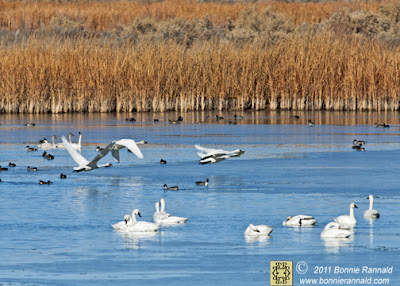
The last Tuesday in November of 2011, while the weather was still nice, I made a visit out to the Stillwater Wildlife Refuge, near Fallon Nevada.   Stillwater, with its numerous isolated wetlands is an important area for migrating shorebirds and has been designated by the Western Hemispheric Shorebird Reserve Network as a site of international importance.


As I was approaching the Auto Tour, which takes you to several viewing areas, I noticed a number of large white birds on the water.  From a distance, they appeared to be the American white pelican that is very common to the lakes and streams in Northwestern Nevada.


After setting up my Nikon D90 with the 500mm lens on the tripod and getting out my bird identification book, I realized that these were Tundra swans.  


Tundra swans breed and summer in the coastal plains of Alaska and Canada.  As winter approaches, they fly south to areas where their food sources of aquatic plants, mollusks and arthropods are more readily available.


During breeding season, the Tundra swan sleeps mostly on land. However in the winter, it sleeps on the water where it is better protected from predators. 


Immature Tundra swans are duller in appearance with grey feathering mixed with the white.


Tundra swans are known to become very vocal when foraging in flocks and will make excited calls to those arriving or departing, sounding similar to the honking of the black goose.   On this day, it was very noisy at the quiet Stillwater Refuge.


What an interesting day to watch these large birds flying in for a landing and then running on the water to get airborne.


For more information:


Photographs Make Great Gifts


What an exciting and interesting photo-adventure this day has been.  I love it when I am drawn to an area and not knowing what to expect I get treated to new experiences. 

Sign up and follow my blog to see where my next photo-adventure will be!


Photography places me in the moment where I can share that moment in time. It becomes a life story as represented by my interaction with the scene. The happiness and beauty or the sorrow and strife; how I focus leaves a lasting impression that might touch the viewer on a spiritual level.


 "Reflecting Nature's Artistry" 


Many of these images are available on my website:

 http://www.bonnierannald.com/ 

For custom matted and framed images:
Off The Wall


No images on this blog are within Public Domain or are available for free download. 

 All rights reserved, world-wide and images protected by Digital Millennium Copyright Act (DMCA). All photography, graphics, text, design, and content is copyrighted by Bonnie Rannald and should not be copied, down-loaded, transferred and re-created in any way without the express consent, in writing to Bonnie Rannald. For information on Bonnie Rannald licensed, right-managed images, please submit a written request.


Sunday, April 17, 2011

Photographing Birds at the Pond


 Backyard Fun With Blackbirds


In the spring, around the second week of April, my back yard comes alive and begins to sound like a jungle when all the migratory birds arrive.  The most interesting grouping is a varied assortment of black birds:  Red-winged, Yellow-headed, Tricolored, Brewer's and even some starlings. 


The birds congregate in the 50 foot, 15.24m elm trees, which are close to the pond, near my back fence and as if on signal, they float down to the pond for drinks and baths. 


Not only are the birds quite entertaining, they also offer some great photo ops when they are drinking and splashing around in the pond.  All I need to do is set up my Nikon D90 with the 500mm 4.0 lens on the tripod and wait quietly on the walkway in the back of my house. Once I become still and out of sight, the birds will begin to trickle down to the waterfall and pond from the trees.  


To be far enough away and go unnoticed by the birds, I am shooting at a distance of approximately 48 feet, 14.63m and even with a 500mm lens the birds appear much smaller in the camera.  Many times, I will have to crop in on the image to bring the bird up to fill the frame.


Since the 500mm lens is manual focus, I really have to concentrate in order to get the bird's eyes in sharp focus. However with the continuous drive of the D90 shooting up to 4.5 frames per second, I have a pretty good chance to catch the action with some sharp images. 


 Opening the aperture to f/8 allows for greater depth of field but also calls for a slower shutter speed.  In order to get up to a speed of 1/500sec. for stop action on the birds, I adjust the ISO from 400 to 800 depending on the light to bump up the shutter speed. 


 I don't think there is anything quite as entertaining as watching birds splashing around in water, taking baths.  It is not necessary to have a pond to attract birds, any shallow object filled with water will do.  The best location is always under or near a tree.  And this has just given me an idea for my next blog entry:  "Let's Make a Birdbath".  So check back next week and see what objects I've found that will make great  bird baths!  


What an exciting and interesting photo-adventure this day has been.  I love it when I am drawn to an area and not knowing what to expect I get treated to new experiences. 

Sign up and follow my blog to see where my next photo-adventure will be!


Photography places me in the moment where I can share that moment in time. It becomes a life story as represented by my interaction with the scene. The happiness and beauty or the sorrow and strife; how I focus leaves a lasting impression that might touch the viewer on a spiritual level.


 "Reflecting Nature's Artistry" 


Many of these images are available on my website:

 http://www.bonnierannald.com/ 

For custom matted and framed images:
Off The Wall


No images on this blog are within Public Domain or are available for free download. 

 All rights reserved, world-wide and images protected by Digital Millennium Copyright Act (DMCA). All photography, graphics, text, design, and content is copyrighted by Bonnie Rannald and should not be copied, down-loaded, transferred and re-created in any way without the express consent, in writing to Bonnie Rannald. For information on Bonnie Rannald licensed, right-managed images, please submit a written request.


Sunday, October 17, 2010

Walker Lake Wild Horses


A Community Unites to Save Their Wild Horses

In this post, I would like to deviate from my usual writings about photography and travels to bring attention to the plight of the Walker Lake Wild Horse Herd that BLM has scheduled for roundup around the middle of November, 2010. The Walker Lake Wild Horse Herd has been on the south end of Walker Lake for well over ten years. The area on the south end of Walker Lake is over ten square miles with fresh ground water and abundant native grasses. These wild horses are actually on land that is controlled by the military and restricted for use by the public. US highway 95 runs along and above the south end of Walker Lake and the wild horses are within easy viewing from the road.

The rational behind BLM’s roundup of these wild horses is due to several horses straying on to the highway and getting hit by cars. The speed limit in this area is 70mph.


The communities of Hawthorne and Walker Lake that are located near the wild horses have united to protest BLM’s roundup of this wild horse herd. On October 16, 2010, a rally was held at Veteran’s Memorial Park in Hawthorne to gather the community support with petitions, letters of protest, banners and photos to try and persuade BLM to cancel this roundup. In order to protect the wild horses and prevent them from getting near the highway, plans are underway to construct a fence at the projected cost of $10,000, to run along the highway and taper back to the water’s edge of the lake.


Allowing the Walker Lake Wild Horse Herd to remain at the south end of the lake will benefit the local communities which have been hit very hard by the recession. A local wild horse advocacy group will be formed and will become involved with the Walker Lake Herd. A monitoring program, which has not been previously developed, will be implemented to study the wild horses in their natural habitat. An additional advocacy group, Horsepower has volunteered to lend support to the community and has offered to fund ¼ of the cost of the fence.


Unfortunately, there is still much controversy over whether the Wild Horses on our American Pubic lands are actually wild horses. Many view the present day wild horses as nothing more than feral offspring that were turned out to fend for themselves because they were no longer useful. Others see the wild horses as nuisances who destroy the fragile desert eco-systems and unlike cattle, provide no benefit to humanity. However, scientists are starting to question the theories and documented history of the wild horse. For example, did the horse become entirely extinct in North America, or were there any survivors? Was it the Spanish who brought the horse back to the Americas, or were they returned earlier by the Norsemen or Chinese Explorers? Has the horse always been with some of the Native American tribes as mentioned in their oral histories?

On January 5, 2007, a statement was introduced to the 110th Congress, entitled Wild Horses as Native North American Wildlife, by Jay F. Kirkpatrick, Ph. D. and Patricia M. Fazio, Ph.D, which supports evidence through DNA analysis that the modern horse is genetically equivalent to a horse, that according to fossil records, represented the most recent specimen prior to extinction in North America. In summary, Kirkpatrick and Fazio conclude that native status for wild horses would place these animals, under law, within a new category for management considerations. As a form of wildlife, embedded with wilderness, ancient behavioral patterns, and the morphology and biology of a sensitive prey species, they may finally be released from the “livestock-gone-loose” application.

The future of the Walker Lake Wild Horse Herd remains uncertain and with all the community effort, will it be enough to persuade BLM to allow these horses to remain free? Only time will tell. There are so many benefits including ecotourism and scientific study that could come from keeping this herd intact, but the most important by far is that an American Icon will be allowed to roam free and wild.


For more information:

Mustangs in danger? Too many horses, too little land

Wild Horses as Native North American Wildlife


What an exciting and interesting photo-adventure this day has been.  I love it when I am drawn to an area and not knowing what to expect I get treated to new experiences. 

Sign up and follow my blog to see where my next photo-adventure will be!


Photography places me in the moment where I can share that moment in time. It becomes a life story as represented by my interaction with the scene. The happiness and beauty or the sorrow and strife; how I focus leaves a lasting impression that might touch the viewer on a spiritual level.


 "Reflecting Nature's Artistry" 


Many of these images are available on my website:

 http://www.bonnierannald.com/ 

For custom matted and framed images:
Off The Wall


No images on this blog are within Public Domain or are available for free download. 

 All rights reserved, world-wide and images protected by Digital Millennium Copyright Act (DMCA). All photography, graphics, text, design, and content is copyrighted by Bonnie Rannald and should not be copied, down-loaded, transferred and re-created in any way without the express consent, in writing to Bonnie Rannald. For information on Bonnie Rannald licensed, right-managed images, please submit a written request.


Monday, September 6, 2010

The Bullock's Oriole

A Summer Visitor to Walker Lake 

Summer is beginning to wind down and as the days get shorter, I’m seeing less of the brightly colored birds that have taken up residence in my backyard. Of all the birds that summer in my area, I enjoy the Bullock’s Orioles the most, watching them scurry around the plants searching for insects, fruit and nectar.

Orioles, like hummingbirds will drink from feeders with sugar water and I have several oriole feeders placed around the yard. The oriole feeders are usually orange, with bigger holes, ¼ inch diameter, and come with larger perches.  A hummingbird feeder can be adapted for orioles by enlarging the holes.


Around the middle of April, the Bullock’s orioles begin to show up from their summer migration. The mature males are easy to spot with their bright orange plumage accented against black, with the white wing patches.


The females and first year-males are more difficult to identify because they have similar colors; gray-brown on the upper areas, with dull yellow on the underparts. The only noticeable difference on the male is the eye-lines and black on the throat.


Over the years from bird watching in my yard, I began to notice a pattern where the orioles were in the yard at dusk, but gone the following morning. I did some inquiring on the Internet and found to my surprise that orioles and songbirds migrate at night. Studies have found that when birds are in the nest, they spend a large portion of their time at night looking out at the stars. It is believed that by watching the stars in the nest, birds develop the ability to recognize star patterns and their movement in the night sky. Furthermore, it is theorized that birds use the North Star for navigation. During spring migration, orioles and other type birds fly to the north, or to the North Star, and in fall they fly away from it, heading south to Mexico. On cloudy or foggy nights, it is believed that birds fly above the clouds and can actually detect the earth’s magnetism through a built-in compass.


With summer drawing to a close, my yard has become quiet and still and I feel sadness as I miss the flurry of activity from my summer visitors. I bid them safe travels on their journey south and will look forward to their return next spring.


For more information, please visit the following links:

Songbird Migration:

Migratory Bird Center
Smithsonian National Zoological Park:


The Bullock's Oriole:


What an exciting and interesting photo-adventure this day has been.  I love it when I am drawn to an area and not knowing what to expect I get treated to new experiences. 

Sign up and follow my blog to see where my next photo-adventure will be!


Photography places me in the moment where I can share that moment in time. It becomes a life story as represented by my interaction with the scene. The happiness and beauty or the sorrow and strife; how I focus leaves a lasting impression that might touch the viewer on a spiritual level.


 "Reflecting Nature's Artistry" 


Many of these images are available on my website:

 http://www.bonnierannald.com/ 

For custom matted and framed images:
Off The Wall


No images on this blog are within Public Domain or are available for free download. 

 All rights reserved, world-wide and images protected by Digital Millennium Copyright Act (DMCA). All photography, graphics, text, design, and content is copyrighted by Bonnie Rannald and should not be copied, down-loaded, transferred and re-created in any way without the express consent, in writing to Bonnie Rannald. For information on Bonnie Rannald licensed, right-managed images, please submit a written request.


Wednesday, June 3, 2009

Roaming Free


WILD BURROS OF NEVADA


A hike in the desert along one of the many natural streams may reveal a group of wild burros quenching their thirst. Burros are curious by nature and most of the time, if they feel unthreatened, will pose for the camera with their heads high and long ears forward. However, on a few rare occasions, I have been warned by the burros not to come any closer. During a hike at Spring Mountain Ranch State Park, I came upon a large group of at least 20 wild burros foraging in an ash grove. As I was preparing my camera, I noticed the herd come to attention and stand their ground, while several began to make snorting sounds. I slowly turned around and retreated to a different trail. I believe in allowing wildlife their territory and taking photos only when the animal is unaware or gives consent. When I’m tracking wildlife, I will use a long focal length lens, either a Nikon 80-200mm F/2.8, or a Nikon 500mm f/4.0. Both lenses allow animals to be photographed up close and personal without invading their space.


Wild burros are not indigenous to the southwestern desert, but are descendents of the African Wild Ass, which was introduced to the Americas in the 1500’s by the Spaniards. The present day wild burro has inhabited the area and thrived since the 1800’s when they were either turned loose or escaped from miners who used them as pack animals for gold and silver prospecting. The hardy, sure-footed modern day wild burro adapts well to the desert’s arid conditions where sources of digestible food are limited and water is even scarcer.


The ability to locate food in a barren terrain allows the wild burro to sustain its diet on dry foliage in the winter months. During the hot summers, when temperatures average 110 degrees Fahrenheit, the burros find shade along streambeds where vegetation is plentiful. If available, their preferred food sources include native grass, Mormon tea shrubs and Palo Verde leaves. A wild burro can experience a 30 percent loss of water, and then become rehydrated in as little as five minutes.


A wild female burro can give birth to one foal a year, after an eleven-month gestation period. Although birthing can occur anytime during the year, it happens most often from June to July. On average, a wild burro will grow to approximately 400 pounds, reach about half the size of a horse and have a life span of around 25 years.


Because of the low number of natural enemies, populations of burros in the wild have grown to around 10,000. A mountain lion is the only natural predator to mature wild burros, but coyotes have been known to prey on the immature, sick or those too old to defend themselves. Due to their increasing numbers, some agencies consider wild burros to be a nuisance and destructive to the fragile desert environment. Many wildlife biologists blame the wild burros for the decline in a number of native plants and animals, including the Bighorn Sheep.


Wild burros, along with wild horses, are protected under the Wild Free-Roaming Horse and Burro Act of 1971. This act mandates the protection, management and control of wild, free-roaming burros and horses on public lands at population levels that ensure a thriving ecological balance. To keep the population in check, the Bureau of Land Management (BLM) places wild burros up for adoption each year through the National Wild Horse and Burro Program.


What an exciting and interesting photo-adventure this day has been.  I love it when I am drawn to an area and not knowing what to expect I get treated to new experiences. 

Sign up and follow my blog to see where my next photo-adventure will be!


Photography places me in the moment where I can share that moment in time. It becomes a life story as represented by my interaction with the scene. The happiness and beauty or the sorrow and strife; how I focus leaves a lasting impression that might touch the viewer on a spiritual level.


 "Reflecting Nature's Artistry" 


Many of these images are available on my website:

 http://www.bonnierannald.com/ 

For custom matted and framed images:
Off The Wall


No images on this blog are within Public Domain or are available for free download. 

 All rights reserved, world-wide and images protected by Digital Millennium Copyright Act (DMCA). All photography, graphics, text, design, and content is copyrighted by Bonnie Rannald and should not be copied, down-loaded, transferred and re-created in any way without the express consent, in writing to Bonnie Rannald. For information on Bonnie Rannald licensed, right-managed images, please submit a written request.