Showing posts with label Landscapes. Show all posts

Tuesday, November 22, 2011

Cedar Breaks, Utah

A Happy Thanksgiving With Fond Memories


With Thanksgiving fast approaching, I'm reminiscing about one the favorite places where I have enjoyed spending the Thanksgiving weekend and that is Cedar Breaks, Utah.  Cedar Breaks is located 23 miles (37.01 km) from Cedar City and standing at 10,000 feet (3048 m) elevation is known as a miniature Bryce Canyon.


During a mild autumn, when the short days are not too cold, Cedar Breaks can be one of the best places in the Southwestern U.S. to catch the splendor of fall colors.


Brilliant aspens growing throughout the landscape and along the roadside are accented against tall evergreens.


Getting off the main road on to any of the numerous dirt trails, an entire day can be spent  admiring the analogous colors of leaves that drape across the path. 
Looking out across the colorful canyon through a knot in the trunk of a Bristlecone Pine, one of the oldest living trees in North America.


After a long day's hike, it's fun to relax and have a picnic by one of numerous streams that flow throughout the area.


At this time of year, it's always wise to keep a careful watch on the weather. Sudden storms can move in with harsh winds, cold temperatures and even snow.


Just come prepared, for Cedar Breaks all covered in snow takes on a difference appearance as a winter wonderland.


 No trip to Cedar Breaks is complete without a visit to Navaho Lake. Formed by an ancient lava flow, it was originally named "Pa-Cu-Ay" by the Paiute which means Cloud Lake.  This high mountain lake was well named because it does appear to be in the clouds and on top of the world.


For more information:
http://www.scenicsouthernutah.com/recreation_areas/navajolake.shtml

http://www.utah.com/nationalsites/cedar_breaks.htm


Photographs Make Great Gifts


What an exciting and interesting photo-adventure this day has been.  I love it when I am drawn to an area and not knowing what to expect I get treated to new experiences. 

Sign up and follow my blog to see where my next photo-adventure will be!


Photography places me in the moment where I can share that moment in time. It becomes a life story as represented by my interaction with the scene. The happiness and beauty or the sorrow and strife; how I focus leaves a lasting impression that might touch the viewer on a spiritual level.


 "Reflecting Nature's Artistry" 


Many of these images are available on my website:

 http://www.bonnierannald.com/ 

For custom matted and framed images:
Off The Wall


No images on this blog are within Public Domain or are available for free download. 

 All rights reserved, world-wide and images protected by Digital Millennium Copyright Act (DMCA). All photography, graphics, text, design, and content is copyrighted by Bonnie Rannald and should not be copied, down-loaded, transferred and re-created in any way without the express consent, in writing to Bonnie Rannald. For information on Bonnie Rannald licensed, right-managed images, please submit a written request.


Tuesday, October 11, 2011

The Ubiquitous Contrail

 Tic Tac Tow Across the Clear Blue Sky


One of my pet peeves with shooting landscape photography is contrails.  I was always told by my mentors that clouds enhance the sky creating interest and drama, but contrails do not belong in nature scenes unless they are part of the theme.  Over the years before Photoshop, I've tried to dodge or hide contrails.  Often, I stood patiently waiting for a contrail to dissipate and then tried to snap the shutter before the next one appeared.  

On days where there is moisture in the air and airplanes are flying at cruise altitude, above 26,000 feet (8 km) where the air is very cold, contrails will be produced from ice particles coming off the aircraft exhaust.


Around the second week in September, I noticed some of the most beautiful contrails glowing over the Gillis Range at sunrise. 
I rushed out with my D90 and the 35-70 2.8 lens to catch the scene.  Just as I was getting set up, the contrails of 2 jets flying from the west appeared overhead and it seemed that the planes were approaching at  almost the same time, coming together at an angle.  


 This was a rare occasion for me and I am still not a fan of having contrails streak across the sky in landscape photos. However, I do love to watch the contrails form from the aircraft, especially when the sun light accents them  at night.


 For more information:


http://www.wrh.noaa.gov/fgz/science/contrail.php?wfo=fgz


What an exciting and interesting photo-adventure this day has been.  I love it when I am drawn to an area and not knowing what to expect I get treated to new experiences. 

Sign up and follow my blog to see where my next photo-adventure will be!


Photography places me in the moment where I can share that moment in time. It becomes a life story as represented by my interaction with the scene. The happiness and beauty or the sorrow and strife; how I focus leaves a lasting impression that might touch the viewer on a spiritual level.


 "Reflecting Nature's Artistry" 


Many of these images are available on my website:

 http://www.bonnierannald.com/ 

For custom matted and framed images:
Off The Wall


No images on this blog are within Public Domain or are available for free download. 

 All rights reserved, world-wide and images protected by Digital Millennium Copyright Act (DMCA). All photography, graphics, text, design, and content is copyrighted by Bonnie Rannald and should not be copied, down-loaded, transferred and re-created in any way without the express consent, in writing to Bonnie Rannald. For information on Bonnie Rannald licensed, right-managed images, please submit a written request.


Wednesday, December 29, 2010

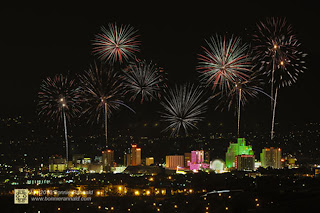
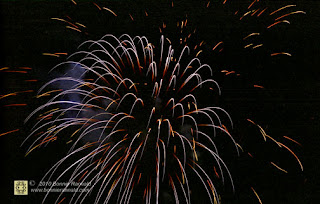
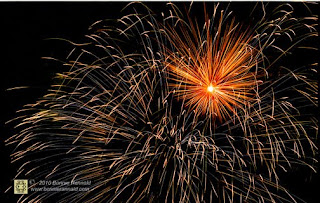
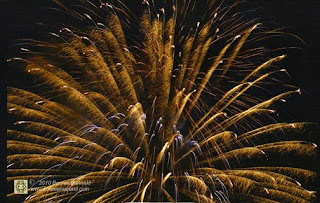
Photographing New Year's Eve Fireworks


Bringing in the New Year


On New Year's Eve many places will celebrate with traditional fireworks so I thought it might be fun in this week's post to give some tips on how I photograph them. When I am going out for a specific photo shoot, I get my equipment ready and packed the day before. To photograph fireworks in late December when it is dark and cold, I will err on the safe side and have extra batteries, the cold weather and longer exposures will drain batteries fast. Also included are additional memory cards, a cable release and a small flash light. The cable release will prevent camera shake and allows me to watch the display while I press the shutter. A flash light will come in handy if you need to change any camera setting.


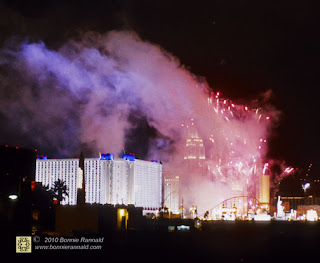
Arriving early is important for scouting out a location with a clear view, up wind of the fireworks, away from tree branches and artificial lighting which could all interfere with the exposures. Since a tripod is a must, I will stay away from crowds where someone could trip over the legs. If you are not able to use a tripod, you can place the camera on the top of a car or some other stationary object. The wind direction can cause problems when the smoke and haze obscures the clarity of fireworks.


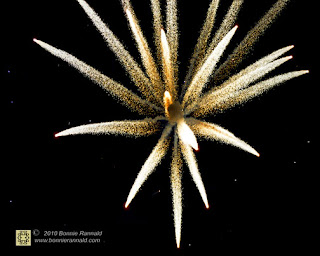
I will pre-set my camera before hand so I do not have to be fumbling around in the dark. With my D90, I use a low ISO of 200 and shoot in the manual setting with the shutter speed on bulb. With the cable release, I hold the shutter open for 1-4 seconds without overexposing the image. The aperture that I prefer to use is f/8, which is in the midrange. I always use the RAW setting for picture quality. And with fireworks, you should use the highest quality setting possible to reduce the amount of compression on your photos. JPEG compression degrades image quality. My preferred lens for fireworks is the Nikon 35-70mm 2.8 which gives me a pretty good range. A wider angle lens, without getting too wide, is better for catching more of the action.


Auto focus doesn't work well for fireworks, so I pre-focus on an object close to where the fireworks will be exploding and use manual focus. I will check the camera's monitor often to see if I am getting the desired results.


Catching the fireworks at the beginning of the exhibition is important, when there is less smoke and haze.


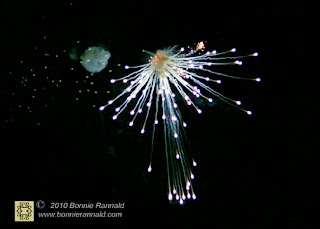
A trick of the trade, place a black velvet scarf or non-shiny object in front of the lens while the shutter is being held open between bursts, then quickly move it away to catch the next one. This allows you to get multiple fireworks in one exposure.


If you are using a point and shoot camera that does not have a fireworks setting, you can set it to Landscape mode (it is the small mountain range). With many point and shoot cameras, the Landscape setting works like setting the lens to Infinity.

I wish every one a happy and safe New Year's. I will see you back the following week of 2011!


What an exciting and interesting photo-adventure this day has been.  I love it when I am drawn to an area and not knowing what to expect I get treated to new experiences. 

Sign up and follow my blog to see where my next photo-adventure will be!


Photography places me in the moment where I can share that moment in time. It becomes a life story as represented by my interaction with the scene. The happiness and beauty or the sorrow and strife; how I focus leaves a lasting impression that might touch the viewer on a spiritual level.


 "Reflecting Nature's Artistry" 


Many of these images are available on my website:

 http://www.bonnierannald.com/ 

For custom matted and framed images:
Off The Wall


No images on this blog are within Public Domain or are available for free download. 

 All rights reserved, world-wide and images protected by Digital Millennium Copyright Act (DMCA). All photography, graphics, text, design, and content is copyrighted by Bonnie Rannald and should not be copied, down-loaded, transferred and re-created in any way without the express consent, in writing to Bonnie Rannald. For information on Bonnie Rannald licensed, right-managed images, please submit a written request.


Sunday, December 19, 2010

Photographs as Fine Art


What Makes Photography Fine Art


This past Monday, December 13, 2010, I was interviewed by Terry Joy on KUNR Radio about my photography. I am always a little on edge when I'm going to be interviewed because you never know what you will be asked and if you are going to stumble over your words. One of his questions was what sets my photography apart from others and I have been thinking about that since the interview, so I decided to incorporate my thoughts in this week's blog post.

When I decided to pursue photography seriously, there was no doubt that the genre of fine art photography was where I wanted to put my energy. And shortly after making this decision, my photographs were juried and I was accepted in one of the largest art shows in Las Vegas, Nevada, the Summerlin Celebration of the Arts. So what actually determines if a photograph is fine art?


"Sand Totem" was my very first enlarged print.

Going back through the evolution of photography, it took a long time to be recognized by the art world and no longer considered the "unwanted step child". In the early days, people thought that mechanics was involved with the camera in making the photography, which did not entail much of a creative process. The photograph was created when light entered a mechanical box, exposing a negative. The negative was then developed with chemicals in a dark room. Since it was a dark room, most people were unaware of the printing process. Like other mediums of art, the camera did not require many fine motor skills or much hand-eye coordination.

In 1889, photographer Peter Henry Emerson founded a fine art photography movement that he entitled "Naturalistic Photography". Emerson's belief was that if a photograph brought aesthetic pleasure to the viewer, it was art. A short time later around 1892, pictorial photography became more accepted by people, thus paving the narrow path of photography as a medium in the art world.

Around 1919, a young man named Ansel Adams was in training to become a concert pianist. However after discovering Yosemite National Park with his Kodak Brownie box camera, he began a sojourn that would dedicate his life to pursuing fine art photography and preserving the wonders of the natural world.

So what is it that makes a photograph fine art? In my opinion, to become a fine art photograph, the image must be created for its aesthetic value and judged for its beauty or meaningfulness. It should be uplifting and thought provoking. However, there is a saying that art does not have to be nice.

Morning Moon, White Sands, New Mexico 

The image should be created as technically perfect as possible with sharp focus, strong subject or story line and accurate color saturation. The resolution of the photograph should be high enough for the image to be enlarged to at least 16x20 inches. The quality of the print material is very important and should be archival with inks that are stable so that the image will not fade beyond acceptable levels for a number of years. And along this line also is the backing board and mounting tape. Cardboard, various paper products and gummed tape will give off gases that eventually cause the print to fade. Furthermore, it is almost impossible to remove the gum when it becomes attached to a print.

Watchman's Moon, Zion, Utah


The old adage that art is in the eye of the beholder goes without saying, however it is my belief that no matter what the medium of art it should be created with precision and style. Photography has come a long way for recognition in the fine art world. And I would recommend to anyone entertaining the idea of becoming a photographic artist to first study the masters in the field, the Ansel Adams, Alfred Eisenstaedt, Anne Geddes, Dorothea Lange, Edward Curtis and any one else that you find both stimulating and inspiring.

Snowtree at La Madre Springs


What an exciting and interesting photo-adventure this day has been.  I love it when I am drawn to an area and not knowing what to expect I get treated to new experiences. 

Sign up and follow my blog to see where my next photo-adventure will be!


Photography places me in the moment where I can share that moment in time. It becomes a life story as represented by my interaction with the scene. The happiness and beauty or the sorrow and strife; how I focus leaves a lasting impression that might touch the viewer on a spiritual level.


 "Reflecting Nature's Artistry" 


Many of these images are available on my website:

 http://www.bonnierannald.com/ 

For custom matted and framed images:
Off The Wall


No images on this blog are within Public Domain or are available for free download. 

 All rights reserved, world-wide and images protected by Digital Millennium Copyright Act (DMCA). All photography, graphics, text, design, and content is copyrighted by Bonnie Rannald and should not be copied, down-loaded, transferred and re-created in any way without the express consent, in writing to Bonnie Rannald. For information on Bonnie Rannald licensed, right-managed images, please submit a written request.


Monday, November 15, 2010

Black and White Digital Photographhy


Shooting in Color for Black and White Digital Photographs

The shorter days and active weather patterns have forced me inside to spend more time on the computer. This past week, I was going over photos and got in the mood to see how they would look in black and white. After opening up Photoshop, I started playing around, removing the color. My D90 has a mode and I can shoot black and white in the camera, but I haven't experimented with it, yet. I prefer to shoot in RAW, and then process the photos in Photoshop where I have the most latitude over the output. This way, I can add or subtract contrast and try out different filters like red or yellow.


We live in such a vivid, colorful world, why would anyone want to do black and white photos? Well, the answers are quite simple to this question. With color photography, textures and forms in subjects often become muddled, so by removing the color, thus creating a black and white image, details become more predominant and stand out.


§

Lighting is very important for black and white photos and should range from highlights to shadows, where the contrast is needed to create emphasis. Gray, overcast skies can augment the scene, especially where there is action in the sky.


§

Clouds help create interest, set moods, and add drama to landscapes. With the black and white photo, it helps to slightly overexpose some of the white clouds but without clipping too much of the details.


§

The composition and subject matter differs in black and white than color and should be kept simple with isolated images.


§
The geometric structure of the scene is emphasized in the black and white photo, and the good old rule of thirds is always important. Lines and curves support the composition by leading the eye into the picture and suggesting a 'flow' to the scene.


§

Everything in the scene should be relevant to the composition.


§

If you are interesting in trying black and white, experiment with your photos and see how appealing they are to you. Now that winter is coming, the skies will be more active, so go out and explore your world, look for different subjects or objects.


§


In conclusion, I would like to mention the Zone system and how it relates to black and white. This is my simplified version. There are nine zones that range from 1, pure black; to 9 that is pure white. Gray is 5, and falls is the middle. Digital cameras tend to overexpose the highlights, so try and expose for the middle to highlighted areas of the scene. You will have to ultimately make the decision on what is the most important part of the scene and go from there. Learning to use the histogram in your camera is a big help and will show you where your exposure falls. If using a point and shoot, study the aperture and shutter speed indicated in the meter so that you will begin to learn the settings for different lighting. Have fun and enjoy the world of photography.

For additional information on Digital Black and White Photography and the Zone System:

http://www.normankoren.com/zonesystem.html

http://dpanswers.com/content/tech_zonesystem.php


What an exciting and interesting photo-adventure this day has been.  I love it when I am drawn to an area and not knowing what to expect I get treated to new experiences. 

Sign up and follow my blog to see where my next photo-adventure will be!


Photography places me in the moment where I can share that moment in time. It becomes a life story as represented by my interaction with the scene. The happiness and beauty or the sorrow and strife; how I focus leaves a lasting impression that might touch the viewer on a spiritual level.


 "Reflecting Nature's Artistry" 


Many of these images are available on my website:

 http://www.bonnierannald.com/ 

For custom matted and framed images:
Off The Wall


No images on this blog are within Public Domain or are available for free download. 

 All rights reserved, world-wide and images protected by Digital Millennium Copyright Act (DMCA). All photography, graphics, text, design, and content is copyrighted by Bonnie Rannald and should not be copied, down-loaded, transferred and re-created in any way without the express consent, in writing to Bonnie Rannald. For information on Bonnie Rannald licensed, right-managed images, please submit a written request.