Showing posts with label Calico Hills. Show all posts

Thursday, April 19, 2018

Fine Art Photography Success or Failure


Success starts with volunteering


Numerous times I have been asked by aspiring photographers to help them get started selling their photos.  I often feel that they think I took some photos, had them printed and was an instant success. In my future blog posts, I hope to recount how over time my road to a successful photographic art career was started.

After moving to Las Vegas, Nevada from Houston, Texas to follow my dream of becoming a collegiate coach, I discovered the Red Rock Canyon National Conservation Area.  I was infatuated with the topography of red sandstone boulders and rugged, colorful mountains.  During my Track and Field coaching tenure we would load up the athletes in an UNLV van and go out for distance training along Red Rock’s 13 mile loop.  The scenery was so awesome and the higher elevation was slightly cooler than urban streets. 


Calico Hills, Red Rock Canyon National Conservation Area, Nevada 


I retired from my profession of teaching and coaching to follow my new dream of working fulltime in the photographic arts.  This allowed me to spend much more time exploring the Red Rock Canyon area.  Looking back, I was as fascinated with the art of Red Rock Canyon as was Ansel Adams of Yosemite.  


Calico Trail, Red Rock Canyon National Conservation Area 


From sunrise to sunset and even after darkness fell across the desert, I was fueled by the passion to record each inspiring moment in this awesome work of nature.  


Spring Morning at Red Rock Canyon National Conservation Area 


One afternoon I was at Pine Creek Trail when I met a law enforcement ranger and he started quizzing me on my new Nikon 8008s film camera. 


Pine Creek Trail, Red Rock Canyon National Conservation Area 


To keep a long story brief, the ranger took an interest in how I was taking photographs and eventually invited me to join the volunteer program to assist the BLM Rangers. 


Bonnie Rannald Photographer at Red Rock Canyon, Nevada 


 As an official Red Rock Volunteer, my duties included inspecting hiking trails for damage or trash removal; plus acting as a hostess to the multitude of visitors, giving directions and general information about hiking and exploring in the Red Rock Canyon.  


Calico Tank Trail, Red Rock Canyon, Nevada 


Working in this official capacity allowed for new opportunities that I might not have experienced otherwise.  It was a responsibility that I embraced.  
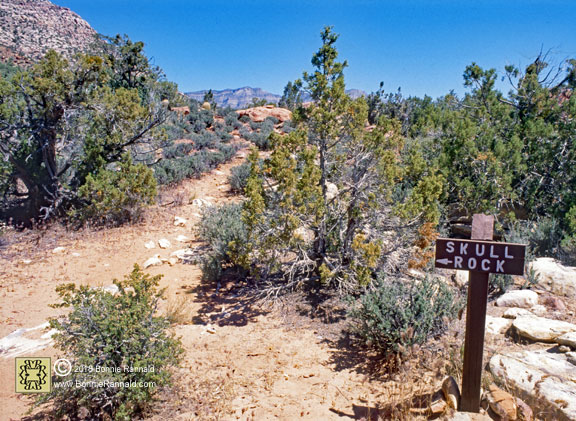

Skull Rock Trailhead, Red Rock Canyon, Nevada 


Furthermore, by giving of my time to others I was blessed with experience and learning opportunities that would help to mold my identity as a photographic artist.  Of all the photography books that I read and studied, the working relationship of being a volunteer gave me hands-on experience.  I was introduced to people from all nationalities which furthered my skills to communicate to others about my love of nature and photography.    


Spring Mountain Sunset, Red Rock Canyon Nevada 


Sign up and follow my blog to see where my next photo-adventure will be!


Photography places me in the moment where I can share that moment in time. It becomes a life story as represented by my interaction with the scene. The happiness and beauty or the sorrow and strife; how I focus leaves a lasting impression that might touch the viewer on a spiritual level.


 "Reflecting Nature's Artistry" 


Many of these images are available on my website:

 http://www.bonnierannald.com/ 


For custom matted and framed images:
Off The Wall


No images on this blog are within Public Domain and are available for free download. 

 All rights reserved, world-wide and images protected by Digital Millennium Copyright Act (DMCA). All photography, graphics, text, design, and content is copyrighted by Bonnie Rannald and should not be copied, down-loaded, transferred and re-created in any way without the express consent, in writing to Bonnie Rannald. For information on Bonnie Rannald licensed, right-managed images, please submit a written request.


Tuesday, February 25, 2014

Nature's Artistry with Rocks


Familiar Shapes in Rocks


Rock formations and clouds share a common bond because interesting shapes and images are often found in them. 

Perceiving images in objects like rocks and clouds is a psychological phenomenon termed Pareidolia.  Many of the master artists including Leonardo da Vinci were aware of pareidolia and used the imagery for artistic expression.

One thing we do have plenty of in the Southwestern Desert is rocks, which most of the time are more numerous than clouds.

Some of my favorite rocks that are great examples pareidolia are as follows:

Natural Bridge in Bryce Canyon National Park, Utah stands out against the snow and the Ponderosa forest and is actually an 85 foot (25.908 m) arch. The rusty-orange flying buttresses of Natural Bridge were formed over millions of years by wind, water, and chemical erosion.


http://www.bonnierannald.com


Bell Rock in Sedona, Arizona has a distinctive shape and is one of the favorite tourist attractions. Standing at 4,919 feet (1499 m), Bell Rock is actually a butte, composed of horizontally bedded sedimentary rock.


http://www.bonnierannald.com


The red and white sandstone of Calico Hills accents the desert landscape in the Red Rock Canyon National Conservation Area (RRCNCA) with peaks that extend up 4870 feet (1484 m).  Towering in the distance behind Calico Hills at 6324 feet (1928 m) is the famous Turtlehead Peak which is the only limestone formation in the Red Rock Canyon National Conservation Area.


http://www.bonnierannald.com


The Chief, wearing a full headdress watches out from a volcanic cliff at the entrance to Wilson Canyon, Nevada.  The two mile long (3.2 km) Wilson Canyon gorge was cut by the Walker River many years ago.


http://www.bonnierannald.com

 
An elephant rock sits atop what was once the lakebed of Walker Lake.  During the last Ice Age, the prehistoric Lake Lahontan covered much of northwestern Nevada, as the climate dried, the lake receded, leaving behind unusual tufa based outcroppings.


http://www.bonnierannald.com


A colorful outcropping of sandstone resembles an eagle at Buffington Pockets which is an area of unusual rock formations and canyons near the Valley of Fire State Park in Southern Nevada.


http://www.bonnierannald.com


In most of the areas where these unique rock formations are located, traces of early humans can be found who left their stories carved in the desert varnish on the faces of these ancient boulders.  Over the millennia, many different cultures have lived and hunted through these canyons and along the streams.


http://www.bonnierannald.com


Today as I walk on the trails, I feel these ancient spirits that still dwell within the rocks.  As I look closely I catch a glimpse of the former inhabitants through the pareidolia that stand out in the rocks.  Maybe that is why I feel so drawn to spend countless hours just gazing at rocks.  And when the gentle breeze touches my face at dusk, I know that they are there watching over their sacred home.


http://www.bonnierannald.com


Summer at Red Rock, Nevada


What an exciting and interesting photo-adventure this day has been.  I love it when I am drawn to an area and not knowing what to expect I get treated to new experiences. 

Sign up and follow my blog to see where my next photo-adventure will be!


Photography places me in the moment where I can share that moment in time. It becomes a life story as represented by my interaction with the scene. The happiness and beauty or the sorrow and strife; how I focus leaves a lasting impression that might touch the viewer on a spiritual level.


 "Reflecting Nature's Artistry" 


Many of these images are available on my website:

 http://www.bonnierannald.com/ 

For custom matted and framed images:
Off The Wall


No images on this blog are within Public Domain or are available for free download. 

 All rights reserved, world-wide and images protected by Digital Millennium Copyright Act (DMCA). All photography, graphics, text, design, and content is copyrighted by Bonnie Rannald and should not be copied, down-loaded, transferred and re-created in any way without the express consent, in writing to Bonnie Rannald. For information on Bonnie Rannald licensed, right-managed images, please submit a written request.


Saturday, January 22, 2011

Red Rock Canyon Conservation Area

Red Rock Canyon, Nevada
Part One of a Three Part Series


The Red Rock Canyon National Conservation Area lies west of Las Vegas, Nevada in  the Mojave Desert and covers 10,000 acres (4,000 ha) of land.  To extensively explore Red Rock Canyon, we must take a voyage back in history to a time around 600 million years ago, when this area was buried under an ancient sea.


Living within the sea, a unique ecosystem of marine life contributed calcium from their bodies that when combined with the minerals from the sea would eventually form deposits giving us the limestone and dolomites that we now call Red Rock.


Today, Turtlehead Peak towers above the surrounding desert as a remnant of the ancient sea with its limestone beds formed from the marine life during the Paleozoic Era. 


Moving forward in time to the Age of the Dinosaurs, 225 million years ago, tectonic shifts caused the earth to move and the sea bed to rise. Rocks, exposed over time oxidized, (rusted) and are now part of the red and orange Moenkopi Formation that is visible across the western U. S.


After many years the climate began to turn arid and around 180 million years ago, the Red Rock area was becoming a desert.  Sand blown in by the winds was accumulating in massive shifting sand dunes that stretched for hundreds of miles, thousands of feet in height.  Over time, the harsh ever changing winds etched patterns as seen in the Aztec Sandstone of Calico Hills.


Alternating hues of red, white and yellow in the Aztec Sandstone are thought to be the result from groundwater churning through the sand and leaching out oxidized iron. 


Iron oxide and calcium carbonate interacted with windblown sand and water, solidifying rock and creating intricate designs.


The colorful Spring Mountains, an escarpment 20 miles long (32km) and around 3,000 feet high (914.4m) are thought to be the western-most extension of the Navajo Sandstone of the Colorado Plateau.  The vivid reds, dark maroons and lighter tones of buff stand out across the eastern flank of the Spring Mountains, with contrasting greens of PiƱon and juniper thriving at their base.


During the monsoon season, water rushes through cracks in the cliff walls creating waterfalls that cascade down hundreds of feet to the streams below. 


Sculpted by the elements of wind, water, sand and intense desert heat, Red Rock stands as a unique creation by nature's hand.  Red Rock as we know it today is a thriving ecosystem, so interconnected and so full of life.

http://www.redrockcanyonlv.org


http://en.wikipedia.org/wiki/Red_Rock_Canyon_National_Conservation_Area


Follow this blog for upcoming post,

Part II Aquifers in Red Rock Canyon


What an exciting and interesting photo-adventure this day has been.  I love it when I am drawn to an area and not knowing what to expect I get treated to new experiences. 

Sign up and follow my blog to see where my next photo-adventure will be!


Photography places me in the moment where I can share that moment in time. It becomes a life story as represented by my interaction with the scene. The happiness and beauty or the sorrow and strife; how I focus leaves a lasting impression that might touch the viewer on a spiritual level.


 "Reflecting Nature's Artistry" 


Many of these images are available on my website:

 http://www.bonnierannald.com/ 

For custom matted and framed images:
Off The Wall


No images on this blog are within Public Domain or are available for free download. 

 All rights reserved, world-wide and images protected by Digital Millennium Copyright Act (DMCA). All photography, graphics, text, design, and content is copyrighted by Bonnie Rannald and should not be copied, down-loaded, transferred and re-created in any way without the express consent, in writing to Bonnie Rannald. For information on Bonnie Rannald licensed, right-managed images, please submit a written request.


Saturday, January 15, 2011

Nevada, Land of Snow Capped Mountains

From deserts to the alpine forests, 
Nevada lives up to its Spanish name of "snow fall"


I have mentioned my adopted state of Nevada so often when posting photographs that I thought it might be interesting to provide some background information on Nevada. The local pronunciation for Nevada is with a short "a", like in cat and never with the long "a" Ne-vah-da, that is often heard on TV or in the movies. Nevada is referred to as the "Silver State" because one of the largest silver lodes in the world was found at the Comstock Mine in Virginia City. It is also know as the "Battle Born State", which is proudly displayed on the deep blue state flag from achieving statehood in 1864 during the Civil War.


http://www.bonnierannald.com


The word Nevada is Spanish, meaning snow fall. The name came from the Spanish explorers after they saw the many tall snowcapped mountains that include 172 summits with 2,000 feet (610m) of prominence, making Nevada the most mountainous state in the U.S. Many of the mountain peaks are above 13,000 feet (4,000m), with the valleys no lower in elevation than 3,000 feet (910m).


http://www.bonnierannald.com


The Spring Mountains are the largest mountain range in Southern Nevada and lie west of Las Vegas in the Red Rock Canyon Conservation Area, which is in the Mojave Desert.


http://www.bonnierannald.com

With the summer temperatures in Southern Nevada reaching well over 100°f (37.7°c), the winters can be cold and bring snow to the higher elevations and even the desert floor. The Aztec Sandstone of Calico Hills stands out against the occasional winter snow storm in the Red Rock Canyon Conservation Area. No matter what the weather, the 10,000 acre (4,000 ha) Red Rock Conservation Area is a must see when visiting Las Vegas. The one-way 13 mile (21 km) paved loop is open during day light hours, providing vehicle access to hiking and interpretive trails.


http://www.bonnierannald.com


In Northern Nevada, the Sierra Nevada Mountains run for 400 miles (640 km) north to south, through Nevada and California, and are around 70 miles (110 km) across, east to west. The highest peak of the Sierras is Mount Humphreys near Bishop, California and stands at almost 14,000 feet (4,300 km).


http://www.bonnierannald.com


Lake Tahoe is set against the backdrop of the Sierra Nevada Mountains and is the largest alpine lake in North America. Located along the border of California and Nevada, Tahoe has a surface elevation of 6,225 feet (1,897m) and a depth of 1,645 feet (591m), making it the second deepest lake in the U.S. after Oregon's Crater Lake.


http://www.bonnierannald.com


Nevada is certainly a state of contrast with its 110,561 sq miles reaching from parts of Death Valley to the Alpine Lake Tahoe. With a population of 2.7 million, the 7th. largest state is only the 35th most populous state. With so much open space and a warm temperate climate, the State of Nevada is a place for adventure with a lot of nature to explore.


http://www.bonnierannald.com


Follow my blog and check back often to see where my next photo-adventure takes me!


http://www.bonnierannald.com


For more information on the State of Nevada:


What an exciting and interesting photo-adventure this day has been.  I love it when I am drawn to an area and not knowing what to expect I get treated to new experiences. 

Sign up and follow my blog to see where my next photo-adventure will be!


Photography places me in the moment where I can share that moment in time. It becomes a life story as represented by my interaction with the scene. The happiness and beauty or the sorrow and strife; how I focus leaves a lasting impression that might touch the viewer on a spiritual level.


 "Reflecting Nature's Artistry" 


Many of these images are available on my website:

 http://www.bonnierannald.com/ 

For custom matted and framed images:
Off The Wall


No images on this blog are within Public Domain or are available for free download. 

 All rights reserved, world-wide and images protected by Digital Millennium Copyright Act (DMCA). All photography, graphics, text, design, and content is copyrighted by Bonnie Rannald and should not be copied, down-loaded, transferred and re-created in any way without the express consent, in writing to Bonnie Rannald. For information on Bonnie Rannald licensed, right-managed images, please submit a written request.