Showing posts with label Bitterbrush. Show all posts

Thursday, August 4, 2016

Desert Wildflowers in the Aurora, Nevada Area


A ghost town alive with blooms 


 Looking for wildflowers in the Great Basin Desert can take me to some very interesting and off the beaten path locations.  Many species of flowering plants have unique adaptations that are specific to the type of soil and elevation. 

http://www.bonnierannald.com


In July, I planned a photo-adventure to the Aurora, Nevada area for the chance of catching any desert wildflowers that might be in bloom following monsoonal rain that moved through the mountains. 

Located in west central Nevada, near the California border, Aurora was a mining town that by 1869 had produced $27 million in gold. However, the gold veins proved to be shallow and due to its remote location, the town of Aurora was deserted and eventually became a ghost town.

http://www.bonnierannald.com


Today not much remains of the town except for the cemetery that is maintained and still receiving souls to be laid to rest under the tall junipers.  


The area south of the cemetery is where I focused my wildflower photography.  At an elevation of 7,441 Feet (2,268 meters) and surrounded by the Humboldt-Toiyable Forest, the wildflowers growing in this area are adapted to the lose, gravelly, alkaline soil; where most of the moisture comes from snowpack in the winter or a summer thunderstorm.  

http://www.bonnierannald.com


The first flowers that I noticed were pale yellow blooms of the Antelope Bitterbrush, Purshia tridentata which seemed to be growing everywhere.  "Bitterbrush" is in the Rosaceae or rose family, was used for medicinal purposes by Native Americans and is a browse plant for wildlife.

http://www.bonnierannald.com


Glancing down close to the ground I saw delicate yellow flowers of Brewer's navarretia, Navarretia brewer extending up from a layer of rocks.  These tiny flowers are under a centimeter in length. 

http://www.bonnierannald.com

 
A unique looking flower, the Cushion Desert Buckwheat, Eriogonum ovalifolium was growing in mats around the gravelly soil and is a species of wild buckwheat. 

http://www.bonnierannald.com


A deep blue-violet Anderson's Larkspur, Delphinium consolida  caught my eye standing out against a yellow flowering Bitterbrush shrub.  Larkspur is in the buttercup family and happens to be the flower for the month of July. 

http://www.bonnierannald.com


Purple clusters of Shaggy Milkvetch, Astragalus malacus thrive on the sandy slopes. 

http://www.bonnierannald.com


 In the pea family, this interesting flowering plant of Milkvetch has soft, white hairs covering its leaves. 

http://www.bonnierannald.com
 
Such dainty white flowers on the Longleaf Phlox, Phlox longifolia seem out of place in a desert environment but this plant can cover dry hillsides where it gives off a sweet fragrance to attract pollinators.  

http://www.bonnierannald.com


Periwinkle flowers of the Two-lobe Larkspur, Delphinium nuttallianum stood out against the pale green desert sage.  This variety of Larkspur prefers gravely soils.  

http://www.bonnierannald.com


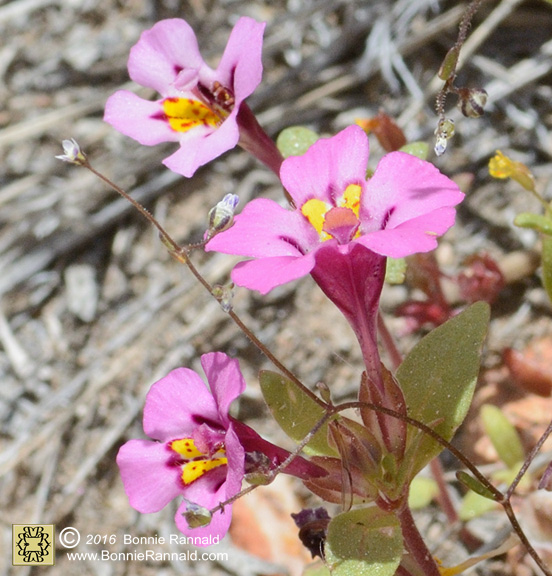
Much to my surprise, I found numerous clusters of the colorful Bigelow's Monkeyflower, Mimulus bigelovii all along the desert floor.  During dry spells, this plant may only grow to an inch off the ground. 

http://www.bonnierannald.com


The Monkeyflower's name comes from the flower markings that resemble the face of a smiling monkey.  Not only is the plant beautiful, all parts are also edible. 
http://www.bonnierannald.com


While I was trekking deeper in to the denser desert vegetation, I began to notice a different type of yellow flowering plant.  Closer inspection revealed that I had come upon the Yellow Milkvetch, Astragalus flavus  This Milkvetch is in the pea family and grows in Selenium soils. 
http://www.bonnierannald.com

As the day was wearing long I began my departure which took me through Lucky Boy Pass.  Rounding a hair-pin turn and there on the roadside stood the most gorgeous stand of Scented Penstemon, Penstemon palmeri

http://www.bonnierannald.com


Carefully parking and bracing my camera, I managed to get a few sharp images of these beautiful flowers.  

http://www.bonnierannald.com


What a rewarding day this turned out to be! Continue to follow my blog and see where my next photo-adventure will go.  

http://www.bonnierannald.com


What an exciting and interesting photo-adventure this day has been.  I love it when I am drawn to an area and not knowing what to expect I get treated to new experiences. 

Sign up and follow my blog to see where my next photo-adventure will be!


Photography places me in the moment where I can share that moment in time. It becomes a life story as represented by my interaction with the scene. The happiness and beauty or the sorrow and strife; how I focus leaves a lasting impression that might touch the viewer on a spiritual level.


 "Reflecting Nature's Artistry" 


Many of these images are available on my website:

 http://www.bonnierannald.com/ 

For custom matted and framed images:
Off The Wall


No images on this blog are within Public Domain or are available for free download. 

 All rights reserved, world-wide and images protected by Digital Millennium Copyright Act (DMCA). All photography, graphics, text, design, and content is copyrighted by Bonnie Rannald and should not be copied, down-loaded, transferred and re-created in any way without the express consent, in writing to Bonnie Rannald. For information on Bonnie Rannald licensed, right-managed images, please submit a written request.


Monday, June 27, 2016

Great Basin Wildflowers on the Drive to Corey Peak


Catching the wildflowers before the summer heat 


Locating the sometimes allusive wildflowers in the Great Basin Desert for photos can be a tricky task.  Most often it comes down to getting lucky with Mother Nature.  Although the Great Basin Desert is noted as a cold desert, the sun is hot and will bake the rocky soil in a matter on minutes.

http://www.bonnierannald.com


What fascinates me with desert wildflowers, along with the fragile beauty, is their tenacity and miracle of adaptation in these harsh environments.  A rocky landscape hardly seems the ideal place for wildflowers to thrive.  However, the Woolly groundsel (Packera cana) in the aster family benefits from growing near rocks due to the mulching effect from the rocks to retain moisture.  

http://www.bonnierannald.com


With the El Nino weather pattern bringing more rain and snow during the winter and spring of 2016, many of the wildflower seeds that were lying dormant have sprung to life.  To take advantage of this rare opportunity, I have been traveling to areas that I hope will have different types of wildflowers that adapt to the elevations.

One area that I recently visited was the mountainous area of Cory Peak.  Located on the east side of the Wassuk Range and to the east of the Sierra Nevada Mountains, Cory Peak stands at 10,520 foot, 3206 meter elevation.  I found that a number of flowering plants were already past their bloom. 

http://www.bonnierannald.com


The white flowers of this large Sierra Mountain Misery shrub had dried up and turned a rusty red color. 

http://www.bonnierannald.com

Mountain Misery or Chamaebatia foliolosa was so named by the miners because of its strange odor and that it seemed to grow everywhere.  Many Native American Tribes valued the plant as a remedy for treating various illness.

Pale yellow flowers of Bitterbrush, one of the first shrubs to bloom in the spring, was in various stages of bloom.  The shrub gives off a pleasant spicy, cinnamon fragrance and provides sustenance for deer and other types of wildlife. 

http://www.bonnierannald.com


Deep purple, thick clusters of Pursh's  Milkvetch (Astragalus purshii)  accented many areas in the disturbed rocky soils. 

http://www.bonnierannald.com


Newberry's Milkvetch with pink-lavender flowers in the Fabaceae family were showing off in the gravelly areas.

http://www.bonnierannald.com


Flowering in the open flat areas at mid-elevations Nuttall's Linanthus (Leptosiphon nuttallii)  of the Phlox genus was adding a delicate touch to the rugged terrain.  

http://www.bonnierannald.com


Accents of bright yellow with the Sulphur buckwheat (Eriogonum umbellatum) a species of wild buckwheat stood out at the mid-elevations.   

http://www.bonnierannald.com


A foreboding looking plant, the Granite prickly phlox (linanthus pungens), was just beginning its bloom in the higher elevation washes.
http://www.bonnierannald.com


One of the largest shrubs of Mormon tea that I have encountered was taking up a huge space along the road-side.  The unique plant appears to have no leaves, just jointed leafless branches.  The branches have been used for medical purposed by numerous peoples; including the Mormon Settlers from which its name is derived.   
http://www.bonnierannald.com

During the month of July, most of the wildflowers at lower elevations will succumb to the desert heat.  Locating these desert wildflowers to me is like being a kid on a treasure hunt, it's so exciting to see what nature creates like with this bouquet of  Desert Paintbrush and Milkvetch.

http://www.bonnierannald.com


Follow my blog to see where my next Photo-adventure takes me.  However till then, if you happen to be in the New York area from June 30th. through July 3rd. stop by and see my photography in the "Revolution of Summer" Exhibition, Curated by Lyza Sahertian NYC ArtHouse; LOFT 227, 227 W. 29th St. 4F New York City.  Reception June 30th, from 7 to 9pm.


What an exciting and interesting photo-adventure this day has been.  I love it when I am drawn to an area and not knowing what to expect I get treated to new experiences. 

Sign up and follow my blog to see where my next photo-adventure will be!


Photography places me in the moment where I can share that moment in time. It becomes a life story as represented by my interaction with the scene. The happiness and beauty or the sorrow and strife; how I focus leaves a lasting impression that might touch the viewer on a spiritual level.


 "Reflecting Nature's Artistry" 


Many of these images are available on my website:

 http://www.bonnierannald.com/ 

For custom matted and framed images:
Off The Wall


No images on this blog are within Public Domain or are available for free download. 

 All rights reserved, world-wide and images protected by Digital Millennium Copyright Act (DMCA). All photography, graphics, text, design, and content is copyrighted by Bonnie Rannald and should not be copied, down-loaded, transferred and re-created in any way without the express consent, in writing to Bonnie Rannald. For information on Bonnie Rannald licensed, right-managed images, please submit a written request.


Thursday, June 23, 2016

Wildflowers bloom on Summer Solstice at Corey Peak, Nevada


Delicate flowers bring gentle beauty to a rugged mountain pass


My quest to record photographically the rare occurrence of desert wildflowers that bloom in the spring has taken me to very remote and interesting locations.  Timing is critical and best planned after there has been some rain.  However, trekking out on dirt roads after a desert rain can be tricky and must be approached with caution.
http://www.bonnierannald.com


On a calm, fair weather day, just before Summer Solstice, I made a day trip to Corey Peak in search of wildflowers.  Corey Peak is the second highest summit in the Wassuk Range, at 10,520 foot elevation (3206 m) and lies to the east of the Sierra Nevada Mountains.

http://www.bonnierannald.com


After turning off from Lucky Boy Pass. the road to Corey Peak is not as well maintained or as wide as the  Lucky Boy Pass road.

http://www.bonnierannald.com


Ascending higher, the road becomes narrow with large rocks and ruts that must be carefully negotiated.

http://www.bonnierannald.com


Looking down at the switchbacks that made for an interesting and challenging drive!

http://www.bonnierannald.com


The view from the summit is breath-taking with dormant volcano peaks rising  up and the  Sierra Nevada Mountains with traces of snow in the background.

http://www.bonnierannald.com


To my delight as I climbed in elevation, I began to see clusters of wildflowers on both sides of the winding road that were thriving in the rocky terrain.  The fragrant, yellow flowers of Bitterbrush seemed to be everywhere, creating a garden setting in the rugged landscape.

http://www.bonnierannald.com


The Desert Milkvetch was in full bloom, with its pale purple flowers.

http://www.bonnierannald.com


The deeper purple Newberry's Milkvetch shared its space with yellow flowers of Woolly Grandsel.

http://www.bonnierannald.com


A beautiful bouquet of red Paintbrush accented with lavender Milkvetch flowers stood out against green and grey desert plants. What an arrangement of nature's artistry!

http://www.bonnierannald.com


As the day progressed, clouds started moving in from the west.  I was thankful for the diffused lighting, however I also had to keep a close watch on the weather changes these clouds might bring.  Driving down this narrow, rocky road in a downpour would be next to impossible.

http://www.bonnierannald.com


Rounding a curve and I noticed a graphic rock-outcropping.  I  stopped for a photo and the  the moon began to rise in the east, coming up behind the rocks.  Feeling at peace with this awesome landscape, I imagined welcoming the summer solstice with the ancient ones.  What a fun and inspirational adventure this wildflower quest turned out to be.

http://www.bonnierannald.com


Check back and follow my blog where I will be posting more details about the wildflowers from my Corey Pass Wildflower photo shoot.

http://www.bonnierannald.com


What an exciting and interesting photo-adventure this day has been.  I love it when I am drawn to an area and not knowing what to expect I get treated to new experiences. 

Sign up and follow my blog to see where my next photo-adventure will be!


Photography places me in the moment where I can share that moment in time. It becomes a life story as represented by my interaction with the scene. The happiness and beauty or the sorrow and strife; how I focus leaves a lasting impression that might touch the viewer on a spiritual level.


 "Reflecting Nature's Artistry" 


Many of these images are available on my website:

 http://www.bonnierannald.com/ 

For custom matted and framed images:
Off The Wall


No images on this blog are within Public Domain or are available for free download. 

 All rights reserved, world-wide and images protected by Digital Millennium Copyright Act (DMCA). All photography, graphics, text, design, and content is copyrighted by Bonnie Rannald and should not be copied, down-loaded, transferred and re-created in any way without the express consent, in writing to Bonnie Rannald. For information on Bonnie Rannald licensed, right-managed images, please submit a written request.


Monday, June 2, 2014

Wildflowers Along the Gabbs Valley Range


Part I 
Exploring around Benton Spring 


With the desert wildflower season starting to bloom, I took a chance on what I might find in the Gabbs area.  The Gabbs Mountain Range extends 40 miles southeastward from Walker Lake to the Pilot Mountains, at 38.6718674 North and -118.1854009 West. Located in the Great Basin Desert, this area seems to have its own micro-climate when the rain producing clouds stall over its rugged mountain ranges.  


http://bonnierannald.com


As I approached the highest point of highway 361with the colorful rock displays, I turned off on to Rabbit Springs Road which wanders through the Gabbs Range.  If I kept driving on the winding dirt road, it would eventually take me back to Walker Lake, however that was not my goal for this flower seeking quest.


http://bonnierannald.com


Turning on the first established trail to the east, I was interested to see what might be blooming along the route to Benton Spring. What I didn't anticipate was that this turn would lead me to some interesting discoveries. 

No sooner had I turned when my eye caught the yellow flowers on a prickly pear cactus. 


http://bonnierannald.com 


Walking to the cactus, I almost stepped on a well camouflaged horned lizard waiting near by to catch any insects that were drawn to the blooms.


http://bonnierannald.com


A short distance ahead I noticed a large bush that was full of yellow blooms. 


http://bonnierannald.com


Drawing closer, I realized the healthy plant was a Bitterbrush.  Regardless of its name, this plant is a major year around food source for wildlife and livestock, especially in the dead of winter.  


http://bonnierannald.com


Walking higher up the trail, a stand of Narrowleaf willows stood out next to the canyon, an indication of the presence of water.  


http://bonnierannald.com


As I ascended further up the trail, there was a depressed area in the base of the canyon that looked like it might be a cave. 


http://bonnierannald.com


Sure enough as I came closer, I discovered that it was the opening to a rather large cave.  Looking down on the dirt trail, I began to notice animal tracks leading to the cave entrance. Most had been left from cattle; however there was a set that might belong to a cougar.  Not knowing what might be enjoying the coolness of the cave, I held back and began to check for additional prints.  To my surprise and just a short distance from the cave was the partially devoured skeleton of a cow.  Since the weather was so warm, I deducted that this had been a recent kill.  


http://bonnierannald.com


Curiosity got the better of me and I quietly approached the cave's entrance.  A shallow pond of water marred with cow prints lay at the opening and I was not that curious to go wading through the dirty water.  Better judgment then took over and I decided to get back with my wildflower photos.  Maybe one day I will do a return visit and be more prepared to go cave exploring!  

Coming down the trail, I stopped for a photo and began to marvel at the landscape with its "Badland" scenery. 


http://bonnierannald.com


What a feeling of desolation one gets from being alone in this primitive area.  My imagination could run wild as I gaze over the Pliocene lake deposits against the sandy brown limestone that were left from the Jurassic age. 


http://bonnierannald.com


What an exciting and interesting photo-adventure this day has been.  I love it when I am drawn to an area and not knowing what to expect I get treated to new experiences. 

Sign up and follow my blog to see where my next photo-adventure will be!


Photography places me in the moment where I can share that moment in time. It becomes a life story as represented by my interaction with the scene. The happiness and beauty or the sorrow and strife; how I focus leaves a lasting impression that might touch the viewer on a spiritual level.


 "Reflecting Nature's Artistry" 


Many of these images are available on my website:

 http://www.bonnierannald.com/ 

For custom matted and framed images:
Off The Wall


No images on this blog are within Public Domain or are available for free download. 

 All rights reserved, world-wide and images protected by Digital Millennium Copyright Act (DMCA). All photography, graphics, text, design, and content is copyrighted by Bonnie Rannald and should not be copied, down-loaded, transferred and re-created in any way without the express consent, in writing to Bonnie Rannald. For information on Bonnie Rannald licensed, right-managed images, please submit a written request.